

Fewer employees, more revenue
English edition. The weekly letter itself is sent by email in French.
Since 2023, Microsoft, Meta and Alphabet have been generating a quarter more revenue per employee. In the SBF 120, six companies are taking the same path, at half the pace. Also this week: fewer than 3 Americans in 100 pay for AI, mostly well-off people of working age; with 48% of adults using it every week, France is almost level with the United States; 61% of American students ask AI to explain a difficult concept; and can you trace what your AI agents have done?
More revenue without more staff: big tech far ahead, six SBF 120 companies on the way
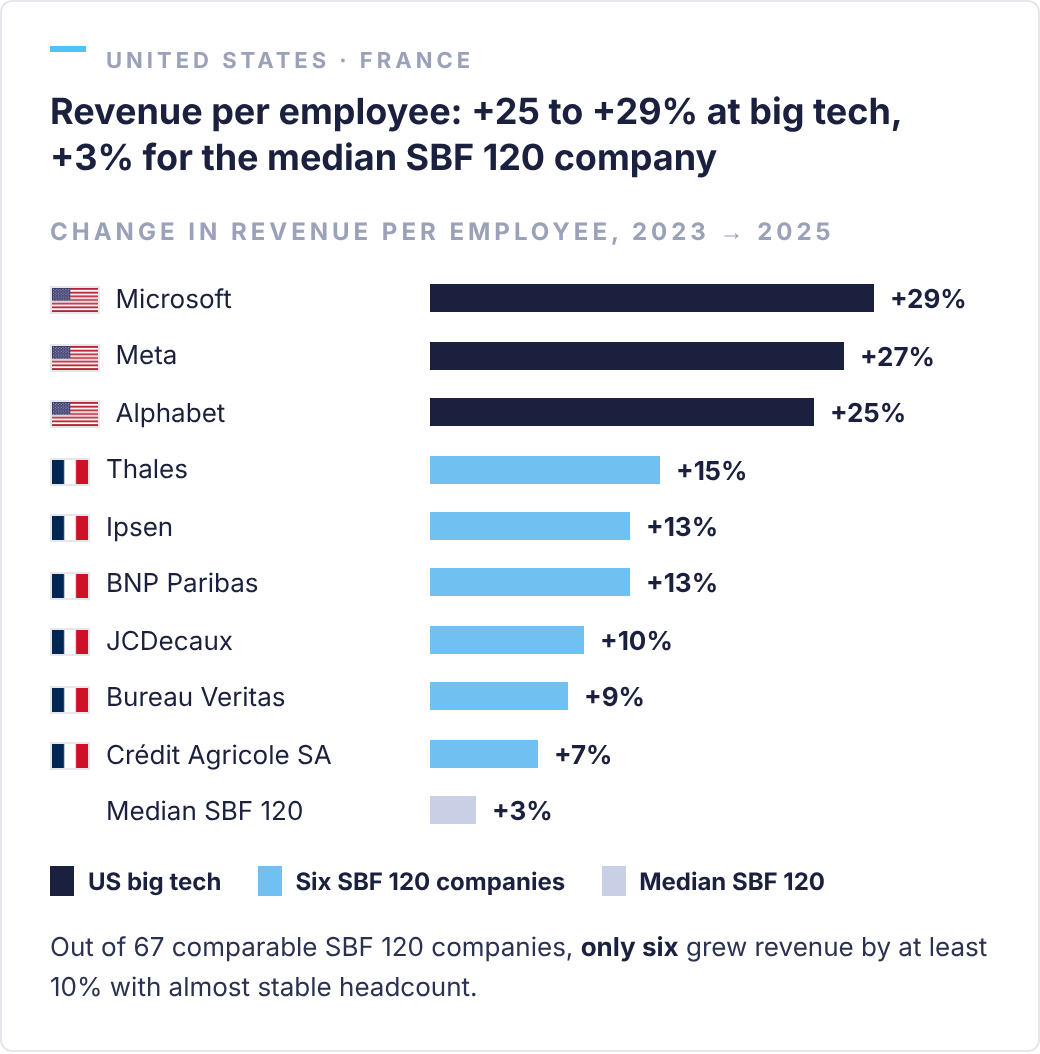
Since generative AI arrived, the American tech giants have been selling far more with barely more staff. A chart by John Burn-Murdoch in the Financial Times showed it: at Meta, Microsoft, Alphabet and Spotify, the revenue curve has pulled away from the headcount curve. Between 2023, the first full year of generative AI, and 2025, Meta increased its revenue by 49% and its headcount by 17%; Microsoft, by 33% and 3%. Each employee brings in a quarter more than two years ago.
Elsewhere, the gap remains small, even in the United States. At Accenture, Deloitte and Visa, revenue and headcount move almost in step. The decoupling is concentrated where many developers work, the first profession to be transformed.
And in France? We ran the numbers for the 120 companies in the SBF 120, the broad Paris stock index, 67 of which can be compared between 2023 and 2025. For the median company: +5% revenue and +3% headcount, so no decoupling. Six companies nonetheless stand out, with at least 10% more revenue and almost stable headcount: Thales, Ipsen, BNP Paribas, Crédit Agricole SA, JCDecaux and Bureau Veritas. Their revenue per employee rose by 7 to 15%, roughly half as fast as at the American giants.
AI does not explain everything: Thales is benefiting from higher defence budgets, Ipsen from sales of its medicines. But BNP Paribas and Crédit Agricole SA clearly present AI as a source of productivity. Conversely, companies that sell human time, such as Capgemini and Sopra Steria, have seen their revenue stall since 2023. The company-by-company detail is in our full analysis.
Sources: Vincent Pavanello, “Growing revenue without growing headcount: a big tech privilege?”, The Observatory's analysis, 1 November 2026; 67 comparable SBF 120 companies, universal registration documents and press releases 2023 to 2025, Mister IA Observatory calculations. · stockanalysis.com, based on the annual reports of Microsoft, Alphabet and Meta, fiscal years 2023 to 2025 (Microsoft: years ending in June); chart by John Burn-Murdoch, Financial Times. Published figures. Reliability: A-.
Who pays for AI? Fewer than 3 Americans in 100, mostly well-off and under 55
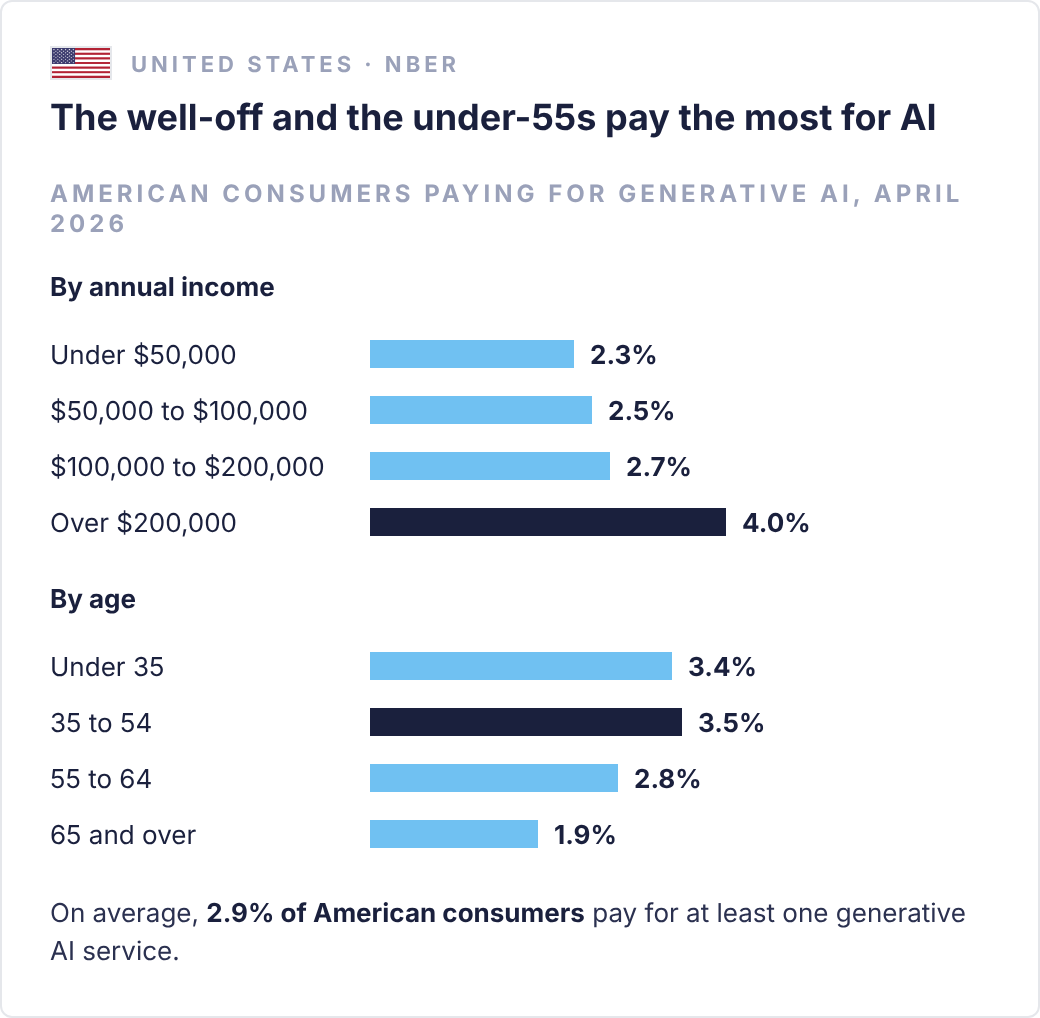
We know how many people use AI. We know much less about who pays for it. Four economists went through the card statements of 174 million American consumers, 114 billion transactions in all, to spot payments to OpenAI, Anthropic, Google and xAI. The result: in April 2026, 2.9% of consumers were paying for at least one subscription to a major generative AI service, more than 6 million Americans. Almost all of them choose the basic plan, at $30 a month or less.
The profile of paying users is clear. Those earning more than $200,000 a year are 1.7 times as likely to pay as those earning less than $50,000. People under 55 pay almost twice as often as older people, but those under 35 pay no more often than 35 to 54-year-olds: it is mainly people of working age who pay. The most educated neighbourhoods pay twice as often as the least educated, and use peaks on the coasts, up to 38% in the ZIP code of the Harvard Business School campus. Card statements say nothing about the gender of paying users.
Above all, these customers are fickle. After a year, 45% of new OpenAI subscribers are still paying, 30% at Anthropic, compared with around 70% for Netflix or Spotify. Switching between providers increases with every new model release, and holding several subscriptions is becoming less common: in June 2024, 44% of Anthropic subscribers also paid for OpenAI, compared with 28% in April 2026.
OpenAI remains far ahead: 2.4% of consumers pay for one of its products, compared with 0.5% for Anthropic, which nonetheless tripled its number of paying users between January and April 2026. For the authors, consumers see less and less difference between AI services: without a clearer gap in quality, competition will weigh on prices. This is a working paper, not yet peer-reviewed.
Source: M. Egan, D. Russel, C. Shi and V. Yao, “Competition in Generative AI: Evidence from Consumer Demand”, NBER w35953, October 2026; credit and debit card payments of 174 million American consumers (114 billion transactions), January 2021 to April 2026, excluding free and business accounts; rates by age and income read from figure 3 (to within 0.1 point). Working paper, not peer-reviewed. Measured data. Reliability: B+.
61% of American students use AI to have a difficult concept explained to them, according to Dartmouth College's survey of 1,003 students interviewed in September 2026. It is the number one use, far ahead of cheating: only 8% copy and paste AI text with almost no edits, even though they think half of their classmates do. One bet is worth making: with a good private tutor, patient and available at any hour, this generation could build skills much faster than the previous ones. And 79% learned to use it on their own.
No, France is not lagging behind: 48% use AI every week, almost as many as in the United States
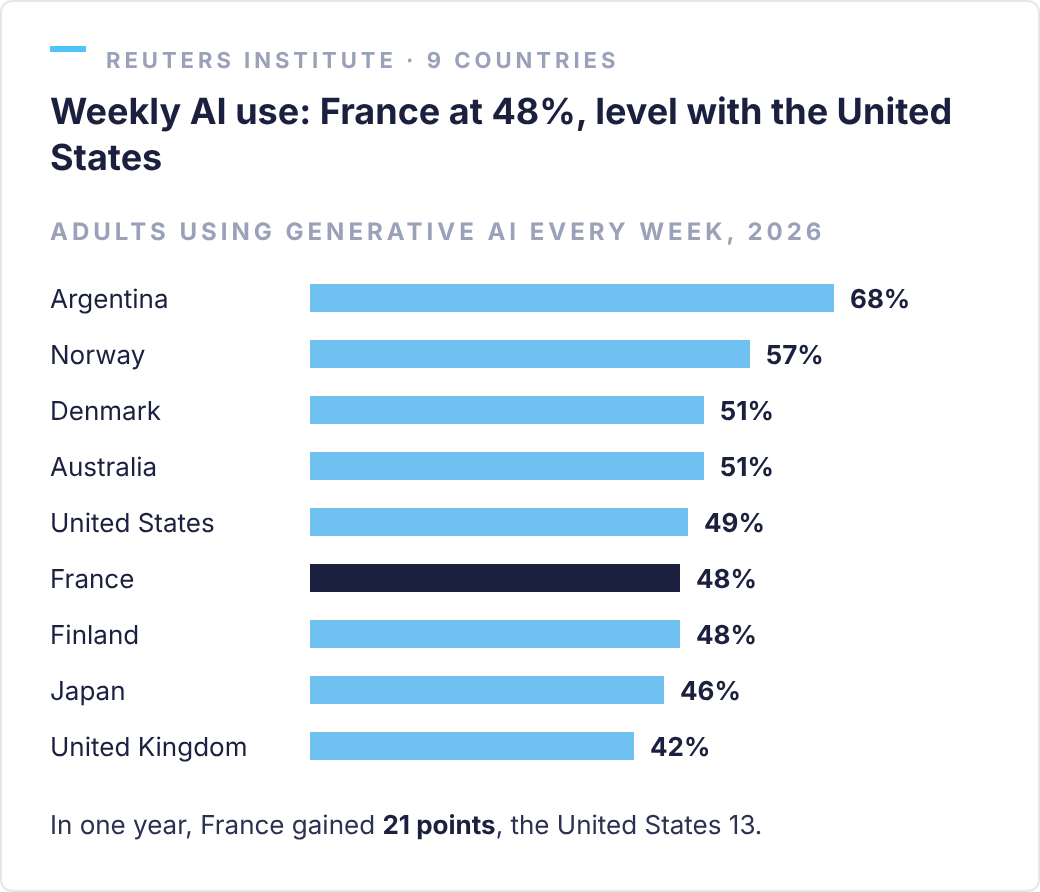
France is often thought to be behind on AI. The figures say otherwise. The Reuters Institute at the University of Oxford had YouGov survey around 2,000 people in each of nine countries, from 14 August to 28 September 2026. In France, 48% of adults now use generative AI every week: almost as many as in the United States (49%), and clearly more than in the United Kingdom (42%), last in the ranking.
Above all, France is catching up fast: 16% in 2024, 27% in 2025, 48% in 2026, or 21 points in a year, compared with 13 in the United States. This is not the first measure pointing in this direction. Microsoft, which tracks use through data from its devices, ranked France 5th in the world in the first quarter of 2026, with 47.8% of 15 to 64-year-olds, well ahead of the United States, 21st with 31.3%; in the second quarter, France moved up to 4th (49.6%).
Another lesson: use does not simply follow wealth. The country where people use AI most is neither Norway nor the United States, but Argentina: 68% of adults every week, 17 points more than in 2025. In our issue 3, Gallup already ranked Americans 14th out of 37 countries for daily use, behind China and Kazakhstan.
A word of caution: this is a self-reported online panel that mixes personal and professional use. France's lag, if there is one, lies with companies: in 2025, 18% of French companies with 10 or more employees used AI, compared with 42% in Denmark (OECD, quoted in our issue 6).
Sources: Reuters Institute (University of Oxford), F. Simon, R. K. Nielsen and R. Fletcher, “Generative AI and News Report 2026”, 29 October 2026; YouGov online panel, around 2,000 people per country in 9 countries, 14 August to 28 September 2026; 2024-2026 trends for 6 countries. Self-reported. Reliability: B+. · Microsoft AI Economy Institute, Global AI Diffusion Report, first quarter of 2026 (May 2026) and second quarter of 2026 (21 September 2026); share of 15 to 64-year-olds using generative AI, based on Microsoft usage data, adjusted. Reliability: B.
Our AI agents act in our tools: could we trace what they have done?
Not always, and this is what separates advanced companies from the rest. Researchers at Harvard Business School, with Microsoft and the consultancy Keystone, surveyed the AI leads of 202 American companies with more than 1,000 employees, all of them AI users, from June to September 2026. In the most advanced quarter, 76% have a searchable record of their agents' activity; in the least advanced quarter, 8%. Only 6 companies out of 202 (3%) combine the four practices studied: an automatically updated inventory of agents, tests rerun when an agent makes a mistake in production, reuse of past errors, and choosing the model according to the task.
Without a record, there is no way of knowing which agent sent an email, changed a file or accessed sensitive data, nor of fixing an error at its source. The most advanced companies also saw their operating margin rise by 5.8 points between 2022 and 2025, compared with 0.4 for the least advanced. This is a correlation, not proof, and the study is partly funded by Microsoft.
Source: Microsoft, “The AI advantage your company can keep”, on HBS working paper 27-038 (Sarkar, Abudurexiti, Beltinger, Daubenspeck and Iansiti), “Organizing AI at Enterprise Scale”, 27 October 2026; 202 American companies with more than 1,000 employees, interviews from June to September 2026; study partly funded by Microsoft and Keystone; working paper not read, figures from Microsoft's post. Self-reported. Reliability: B-.
- 01Since 2023, the American tech giants have been generating a quarter more revenue per employee. In the SBF 120, only six companies are taking the same path, at half the pace.
- 02Fewer than 3 Americans in 100 pay for AI, more often well-off and under 55, and they switch providers easily.
- 03France is not lagging behind: 48% of adults use AI every week, almost as many as in the United States (49%), and 21 points more in a year.
- ?76% of the most advanced companies can trace what their AI agents do, compared with 8% of the least advanced.
Get the weekly letter
Every week: the data signals that matter, the number of the week, and what we measure among our clients. Free, no advertising. The letter is sent in French; every issue is also published in English on this site.
One letter a week, on Sunday, written in French. Unsubscribe in one click, at any time.