

Towards 100% AI licence coverage?
English edition. The weekly letter itself is sent by email in French.
Uber is giving ChatGPT to its 30,000 employees, Accenture is giving Copilot to 743,000: a few companies are starting to equip their entire workforce. Among our clients, licence coverage has doubled in nine months, from 9.8% to 19.0%. Also this week: when AI takes the cold leads, salespeople do not sell more; Copilot is used by 95% of the US banks surveyed, with Claude and ChatGPT behind; 32% of organisations have dropped a software purchase because they could build it with AI; and Claude on Google Cloud, with no European option.
The best leads to salespeople, the rest to AI: why sales did not follow
Do your salespeople spend too much time on leads that will never buy? A Chinese online health insurance platform, which calls back every day the customers who abandoned a purchase on its website, made a decision in 2024: it splits leads between its salespeople and AI according to their quality. Hot leads, customers who reached the payment page, go to the salespeople; cold leads go to an AI voice agent, which calls and follows up on its own. It is a smart way to divide the roles: humans where they earn the most, AI on the rest.
Six researchers studied more than 560,000 calls around this change. The result is counter-intuitive: the salespeople, who now receive better leads, do not sell more. On hot leads, they even close slightly fewer than before: 3.7% against 4.4%.
The explanation is human. A salesperson who receives almost nothing but hot leads knows more will keep coming all day: each lead counts for less. They hand it back to the shared queue faster (more than one lead in five, against one in seven before) and cut their calls short. The effect is strongest in the morning, when the day promises the most good leads.
It is a very sales-specific example, but the lesson applies to every job: when AI takes over part of the work, people change the way they do the rest. There is change management to be done, to learn to work in a world where AI is always an alternative. The study is a working paper, not yet peer-reviewed.
Source: X. Fu, S. Luo, N. Ramasubbu, P. Shen, X. Wang and Y. Wang, “When Better Opportunities Backfire: Service Worker Responses to Parallel AI Deployment in Customer Acquisition”, arXiv 2610.25603, September 2026; 409,622 calls by salespeople and 157,468 calls by the AI, 60 days before and after 28 August 2024, Chinese online health insurance brokerage platform (anonymised); effects estimated with a regression discontinuity in time. Working paper, not peer-reviewed. Reliability: B.
Towards 100% AI licence coverage?
On 22 October, Uber announced it was giving ChatGPT to its more than 30,000 employees, after a pilot with 1,000 people. The day before, Microsoft announced that Volkswagen had equipped more than 330,000 employees with Copilot, half of the group. A few companies are starting to talk no longer about pilots but about all their employees.
Accenture is rolling out Copilot to around 743,000 people, 95% of its workforce; EY to its more than 400,000 employees; KPMG is giving Claude and Copilot to its 276,000 employees; Fujitsu, Claude to around 100,000. In banking, BBVA has opened ChatGPT to its 120,000 employees and Commonwealth Bank of Australia to the whole company. Many of these are targets with no end date, and consulting firms also equip their staff in order to sell these tools to their clients afterwards.
These announcements remain exceptions. Most companies have equipped only a small share of their employees. We measure this among our licence clients. Among those already equipped in January, the coverage rate, that is, the number of paid AI licences divided by total headcount, was then 9.8%. It reached 19.0% at the end of October: it has doubled in nine months.
We are far from 100%, but the slope is clear: once the first licences are in place, companies widen access. The next step is making sure that equipped employees actually use them.
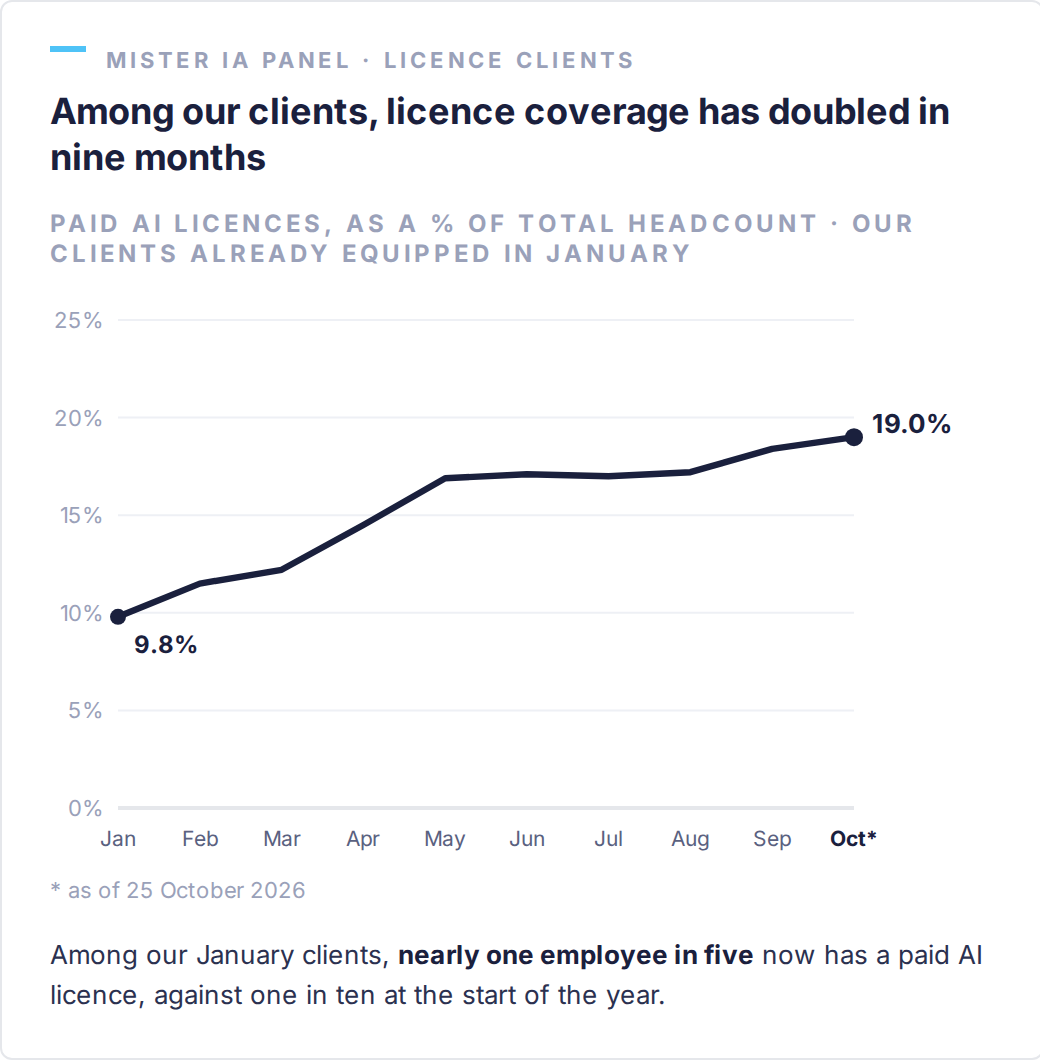
Sources: Mister IA Panel, licence coverage among licence clients, paid AI licences as a share of total headcount, average of clients already equipped in January 2026, January to 25 October 2026; measured data. Reliability: A-. · OpenAI, “Uber déploie ChatGPT Work pour tous ses employés avec OpenAI” (Uber rolls out ChatGPT Work to all its employees), 22 October 2026. · Microsoft, “Microsoft empowers more than 330,000 Volkswagen Group employees with Copilot”, 21 October 2026; group workforce: 662,942 employees at the end of 2025 (annual report). · Microsoft, “Accenture is rolling out Copilot to a workforce the size of Denver”, 27 April 2026. · EY and Microsoft, announcement of a global initiative (Copilot rollout to all employees), 21 May 2026. · Anthropic, “KPMG integrates Claude across its workforce”, 19 May 2026; and Microsoft, KPMG, 9 June 2026. · OpenAI, “BBVA collaboration expansion”, 12 December 2025. · Fujitsu, “Fujitsu signs strategic partnership with Anthropic”, 27 May 2026. · OpenAI, “Commonwealth Bank of Australia”, 9 December 2025. Company and vendor announcements. Reliability: B.
32% of respondents to McKinsey's global AI survey say their organisation has dropped the purchase of at least one piece of software or feature because it could build it itself with coding agents. This is the figure that gives substance to the “SaaSpocalypse”: since the winter, markets have used this name for the fall in the share prices of subscription software vendors, driven by fears that their clients will build their own tools with AI. Three researchers at the University of Utah add some nuance: the length of tasks the best coding agents can complete doubles roughly every four months, but software purchases are not yet falling in US investment figures. And the survey says neither how much money was saved nor whether the tools built hold up.
In US banks, Copilot is everywhere, with Claude and ChatGPT as challengers
Bank Director, the magazine for US bank boards, publishes a technology survey every year. The 2026 edition, funded by the banking software vendor Jack Henry, surveyed 136 executives and directors of banks with less than $100 billion in assets in June and July: regional and community banks, not giants like JPMorgan. 72% of these banks already use generative AI, 30% use AI agents.
On tools, Microsoft crushes the competition: 95% of executives cite Copilot. This is the Microsoft 365 effect, already installed everywhere; the survey does not say whether this means the free version built into email or paid licences. Behind it, Claude (26%) is ahead of ChatGPT (22%), then Gemini (11%): the second tool, the one a team picks on top of Copilot, is a race between Anthropic and OpenAI.
Use cases remain mostly internal: operations (80%), marketing (73%), compliance (66%), lending (49%); customer service only comes next (29%). Banks that have not started yet first cite a lack of skills (65%) and regulatory risk (59%). A survey with a small sample and multiple choices: read it as an order of magnitude.
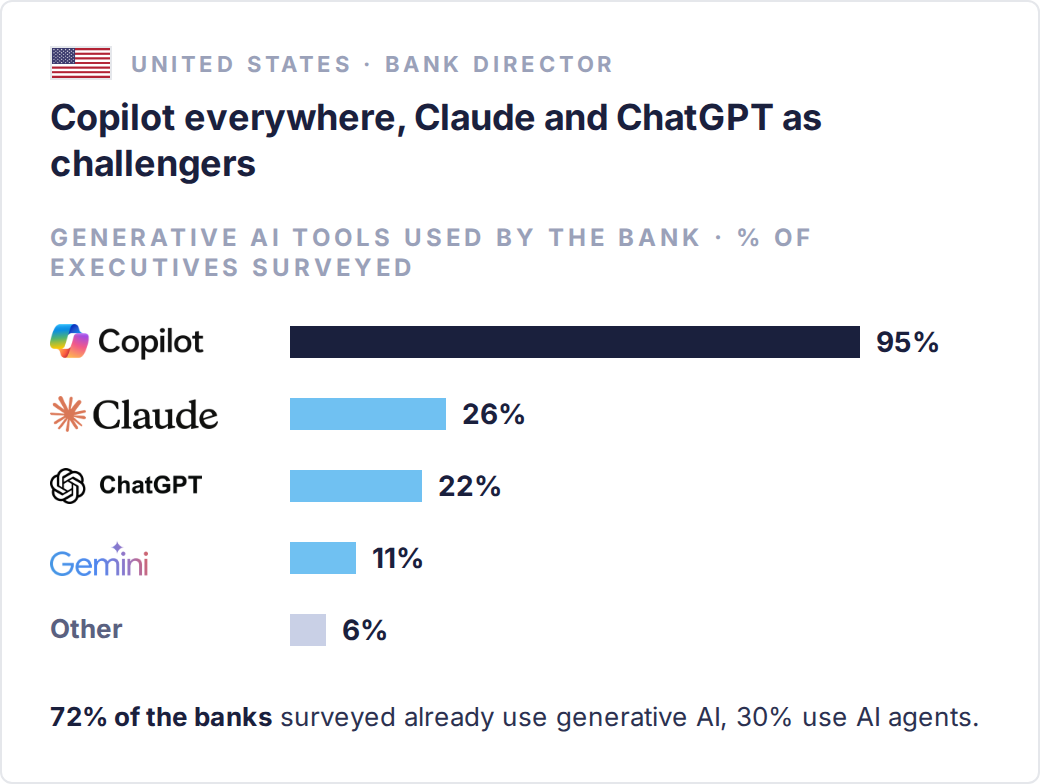
Source: Bank Director, “2026 Technology Survey”, sponsored by Jack Henry, September 2026; 136 directors and executives (CEOs, COOs, CTOs) of US banks with less than $100 billion in assets, June-July 2026; multiple choice, base of the question not specified. Self-reported. Reliability: B-.
Does buying Claude on Google Cloud guarantee that our data stays in Europe?
Not with the new offering. Since 22 October, a company can buy the full Claude API from its Google Cloud account: same credentials, same invoice, same spending commitment. But in this “Anthropic managed” offering, Anthropic runs the service on its own servers, which may be outside Google Cloud, and processes the data under its own terms. Processing happens either “globally” (the default) or in the United States, and retained data is stored in the United States. There is no European option.
To keep data in Europe, you need the other offering, “Google managed” Claude on Google Cloud's AI platform. Google is the only processor there, the service runs in the region you choose, European regions included, with the usual Google Cloud protections such as customer-managed encryption keys. In return, new Claude features do not always arrive there on day one. Two offerings with almost the same name, two very different levels of guarantee.
Sources: Google Cloud, “Use Claude models on Google Cloud (Anthropic managed)”, accessed 25 October 2026. · Anthropic, “Data residency” documentation, accessed 25 October 2026.
- 01When AI takes the cold leads, salespeople receive better leads but take less care of them: they do not sell more. Working alongside AI is something people have to learn.
- 02A few companies, such as Uber and Accenture, already equip all their employees. Among our clients, licence coverage has doubled in nine months, from 9.8% to 19.0%: we are still far from 100%.
- 03In US regional banks, Copilot is everywhere (95%); for the second tool, Claude (26%) is ahead of ChatGPT (22%).
- ?Claude bought on Google Cloud does not come with the same guarantees depending on the offering: the Anthropic managed version has no European option.
Get the weekly letter
Every week: the data signals that matter, the number of the week, and what we measure among our clients. Free, no advertising. The letter is sent in French; every issue is also published in English on this site.
One letter a week, on Sunday, written in French. Unsubscribe in one click, at any time.