

On Fridays, 21% fewer messages are sent to AI than on Wednesdays
English edition. The weekly letter itself is sent by email in French.
Across the 10,000 licences we manage, Wednesday is the day people write to AI the most, Friday the day they write the least, and 7.4% of messages are sent at the weekend. Also this week: only one French SME in 20 has paid for AI training, PwC's four employee profiles facing AI, skills used six times more in the most advanced companies, and our new section, the security question of the week.
France Num barometer: one French SME in 20 has paid for AI training
France Num is the French government's programme for small-business digitalisation, run by the Directorate General for Enterprise (DGE). Its barometer, published by the DGE on 28 September, surveyed more than 9,600 very small businesses and SMEs (TPE-PME) and shows a real take-off: 40% of these businesses use AI, 14 points more than in 2025, and 53% of the SMEs among them. One in five already pays for an AI solution (19%, and 32% of the SMEs).
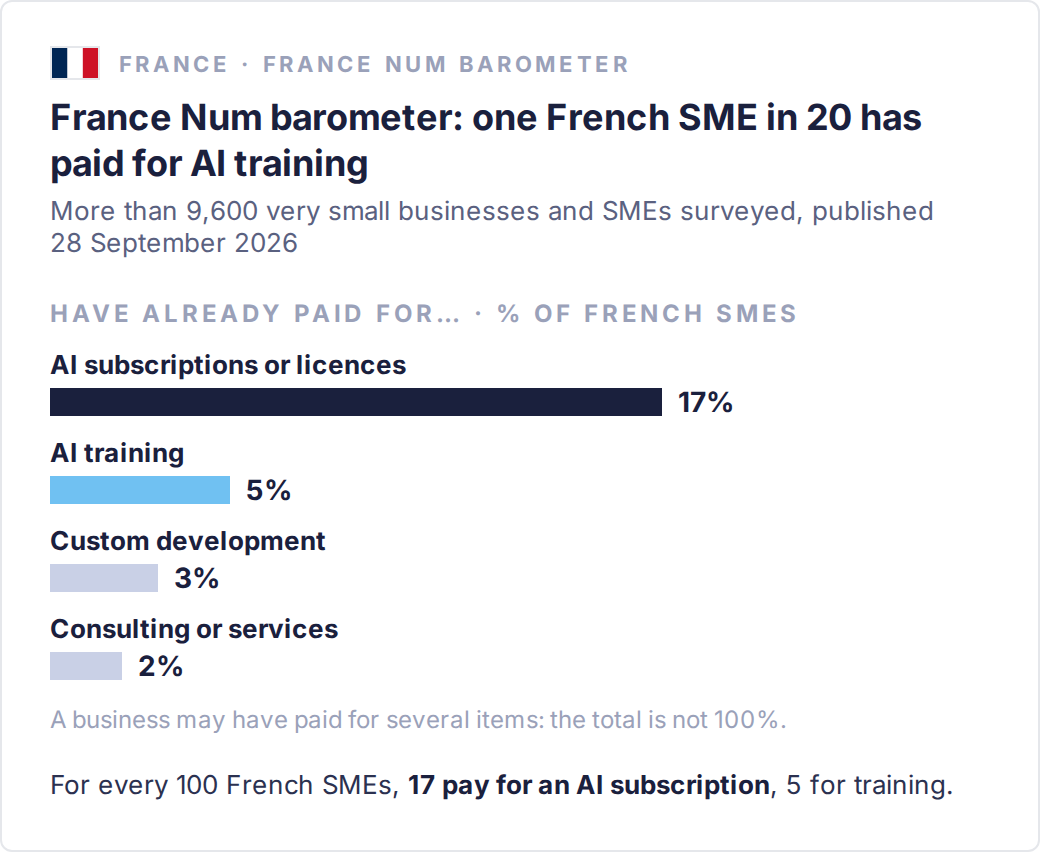
The barometer also asks each business what it has already paid for in AI. 17% of these businesses have paid for subscriptions or licences. Only 5%, or one in 20, have paid for training. 3% have had a custom tool developed, and 2% have bought consulting. These figures are not a breakdown of the budget: each one is the share of businesses that have paid for that item, and the same business may have paid for several. So three times as many businesses pay for a tool as pay for training.
Those that pay are also the most satisfied: 68% of businesses that use AI say its effect is positive, and 84% of those that pay for a solution. This does not prove that paying is enough: the businesses that pay are often the ones that had already found a use for AI.
We think that buying AI tools without training people is a mistake: a subscription does not tell anyone what to ask AI in their own job. Without training, AI is mostly used to correct a text and to run a search, as the Greenworking study showed last week.
Sources: Baromètre France Num 2026: le numérique et l'intelligence artificielle dans les TPE et PME (France Num 2026 barometer: digital tools and AI in very small businesses and SMEs), Directorate General for Enterprise, published 28 September 2026; more than 9,600 very small businesses and SMEs surveyed; share of businesses reporting each type of AI spending. Self-reported. Reliability: A. · ministry press release, 28 September 2026.
PwC survey: the four employee profiles facing AI
PwC surveyed 49,364 employees in 48 countries in May and June 2026. Use is growing fast: 64% used AI at work in the past year, 10 points more than in 2025, and 22% use it every day, against 14% a year earlier. Above all, the survey offers a classification that any HR director can use: four employee profiles, sorted by what AI brings them and by how rare their skills are.
The front-runners (14% of employees) have rare skills and get a lot out of AI: half of them use it every day. The AI insurgents (18%) have less rare skills, but use AI to get more done. The indispensables (11%) have rare expertise and make little use of AI. That leaves the engine room: 56% of employees, the people who keep the business running day to day, of whom only 11% use AI every day.
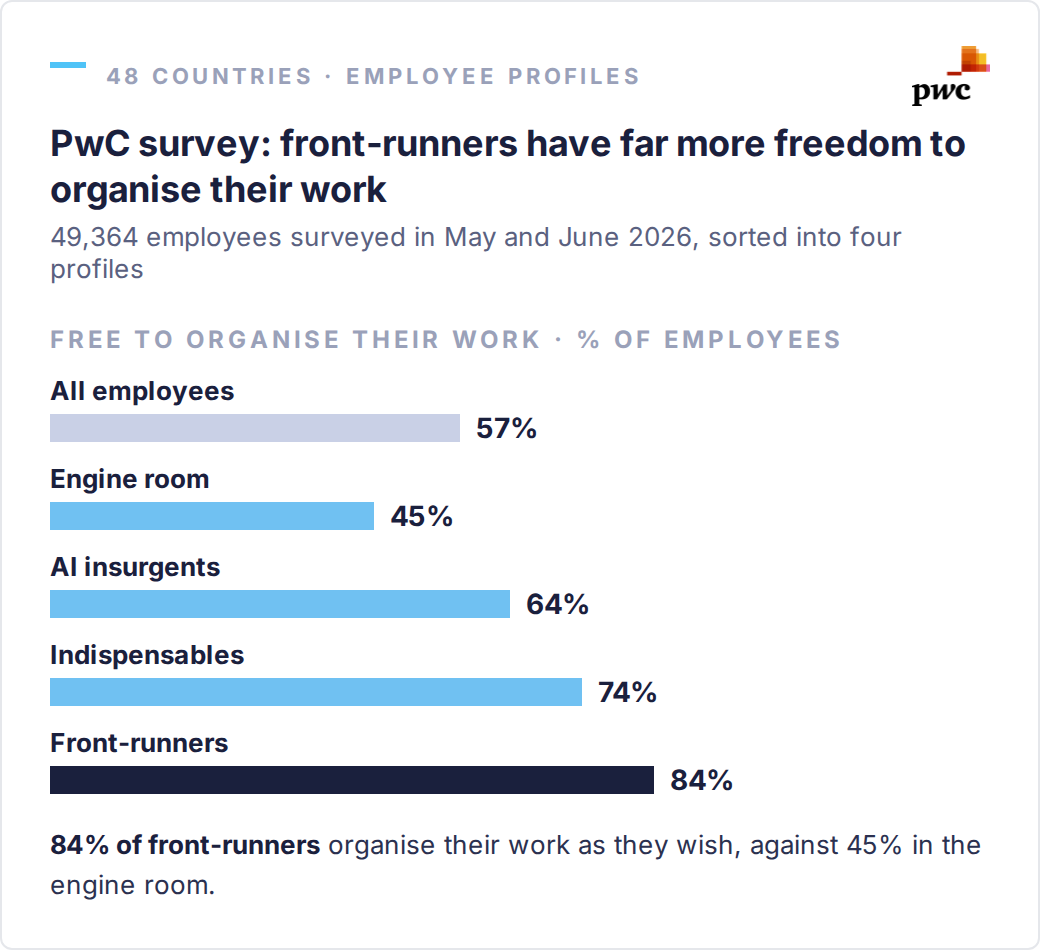
The gaps are clear. 84% of front-runners say they can organise their work as they wish, against 45% in the engine room. 82% trust their manager, against 40%. Nearly 80% have access to the training they need, against less than 40%. And their employer rewards good use of AI almost twice as often.
Front-runners also have rare skills, and therefore more latitude: AI does not explain everything. But for an HR director, the message is twofold: most employees remain far from AI, and access to training is falling (51% of employees, against 59% last year). PwC advises against treating all profiles the same way, and recommends freeing up time for learning rather than adding it on top of the workload.
Source: PwC, Global Workforce Hopes and Fears Survey 2026, published 29 September 2026; 49,364 employees, 48 countries and territories, 29 sectors, May and June 2026; shares of the two middle profiles (18% and 11%) as reported by The Next Web and ITPro. Self-reported. Reliability: B.
In the companies that use AI the most, employees use skills six times as much as in a “typical” company: 19% of weekly active users, against 3%. At OpenAI itself, the figure is 93%. A skill is a saved instruction that the AI reuses on demand: how to write up meeting minutes, review a contract or prepare a sales proposal. The more people use AI, the more they use these advanced features, and the gap is widening: the most advanced companies get AI to produce 8.3 times more text per user than typical companies, up from 2.6 times in January.
On Fridays, our clients send fewer messages to AI
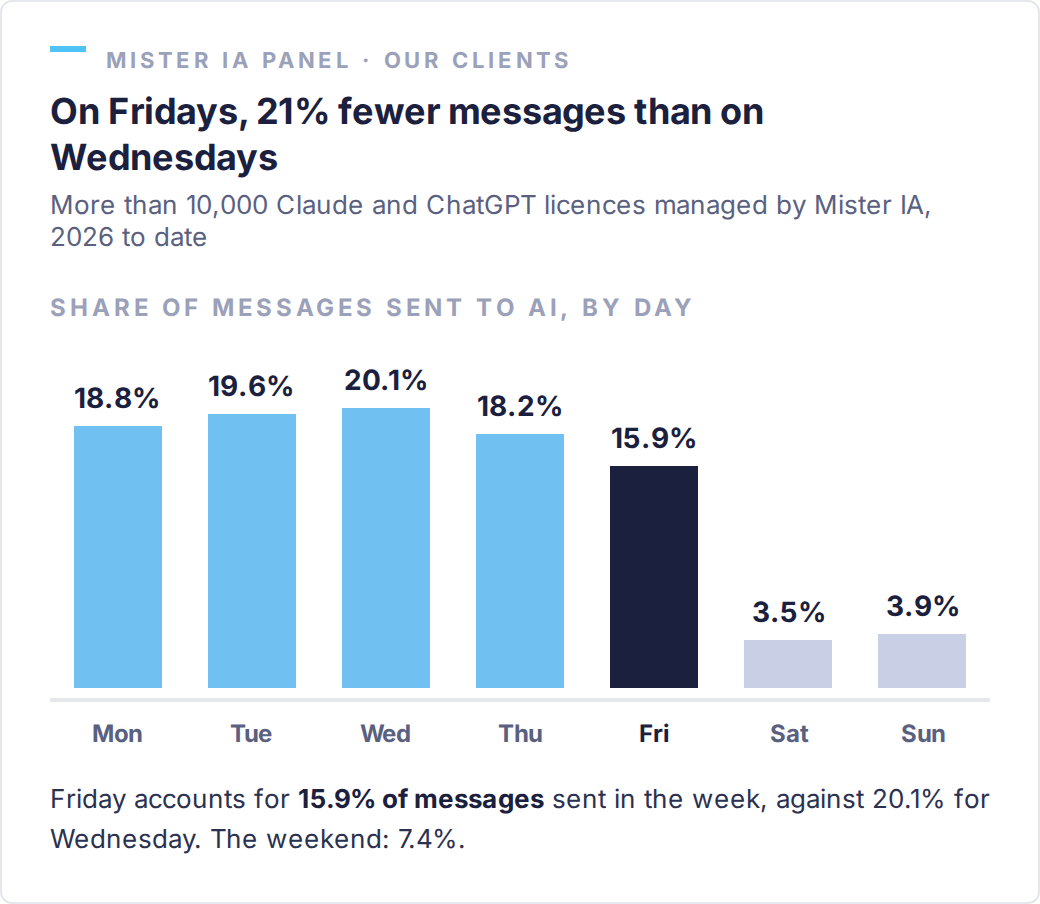
Mister IA manages more than 10,000 Claude and ChatGPT licences for its clients. We looked at the day of the week on which messages to AI have been sent since the start of 2026. Activity rises until Wednesday, the busiest day with 20.1% of messages, then falls back.
Friday drops off: 15.9% of messages, or 21% fewer than on Wednesday, and 14% fewer than on an average working day. Our data does not say why. Shorter days or different tasks at the end of the week are possible explanations, but we cannot check them.
Use does not stop at the weekend: 7.4% of messages are sent on Saturday (3.5%) or Sunday (3.9%), slightly more on Sunday. These tools are provided by the employer. Either employees use them for personal matters, or they work at weekends: we cannot tell which, and it is not necessarily a problem.
Source: Mister IA Panel, more than 10,000 Claude and ChatGPT licences managed by Mister IA for its clients; share of messages sent on each day of the week since January 2026, calculated over 168 hourly slots. Measured usage data.
Our teams use AI: does the EU AI Act already apply to us?
Yes. The EU AI Act, the European regulation on artificial intelligence, does not only cover the companies that build AI tools: it also applies to the companies that use them. And many are unaware of this: according to the barometer by the ESSCA business school and Forvis Mazars, conducted in March 2026 among 826 IT and digital professionals in four European countries including France, only 28% know the AI Act well, no more than in 2024 (29%). And 56% of companies have not written down ethical rules on AI, even though 66% report unauthorised use and 35% already use AI agents.
What already applies: since February 2025, some uses are banned, such as inferring employees' emotions, and companies must take steps to ensure their staff are AI literate (an obligation relaxed in July 2026, but still in force). And tools used to recruit, assess or allocate work to employees will be classed as high risk, with obligations from 2 December 2027.
Sources: ESSCA (AI for Sustainability Institute) and Forvis Mazars, Baromètre IA 2026 Entreprise et Durabilité (2026 AI, business and sustainability barometer), published 1 October 2026; 826 IT and digital professionals in France, the United Kingdom, Germany and Spain, March 2026. Self-reported. Reliability: B. · Regulation (EU) 2024/1689 on artificial intelligence (AI Act), Articles 4, 5 and 26, Annex III. · Regulation (EU) 2026/1744 (digital omnibus on AI), Official Journal of the EU, 24 July 2026.
- 01One French SME in 20 has paid for AI training, against 17% that pay for a subscription: businesses are three times more likely to buy tools than to train their people.
- 0256% of employees make up PwC's engine room: little AI, little training, less trust. The front-runners, 14%, have far more freedom to organise their work.
- 03At our clients, Wednesday is the day with the most messages sent to AI and Friday the day with the fewest (21% fewer). The weekend accounts for 7.4% of messages.
- ?Only 28% of digital professionals know the AI Act well, no more than in 2024, yet a company that uses AI already has obligations.
Get the weekly letter
Every week: the data signals that matter, the number of the week, and what we measure among our clients. Free, no advertising. The letter is sent in French; every issue is also published in English on this site.
One letter a week, on Sunday, written in French. Unsubscribe in one click, at any time.