

Company agreements on AI are doubling every year
English edition. The weekly letter itself is sent by email in French.
Collective bargaining has taken up AI: about 115 company agreements in 2024, 215 in 2025. Also this week: one AI user in three uses it without their employer knowing, the more people use AI the more they use it outside their own job, and 96% of law interns used AI this summer.
One AI user in three uses it without their employer knowing
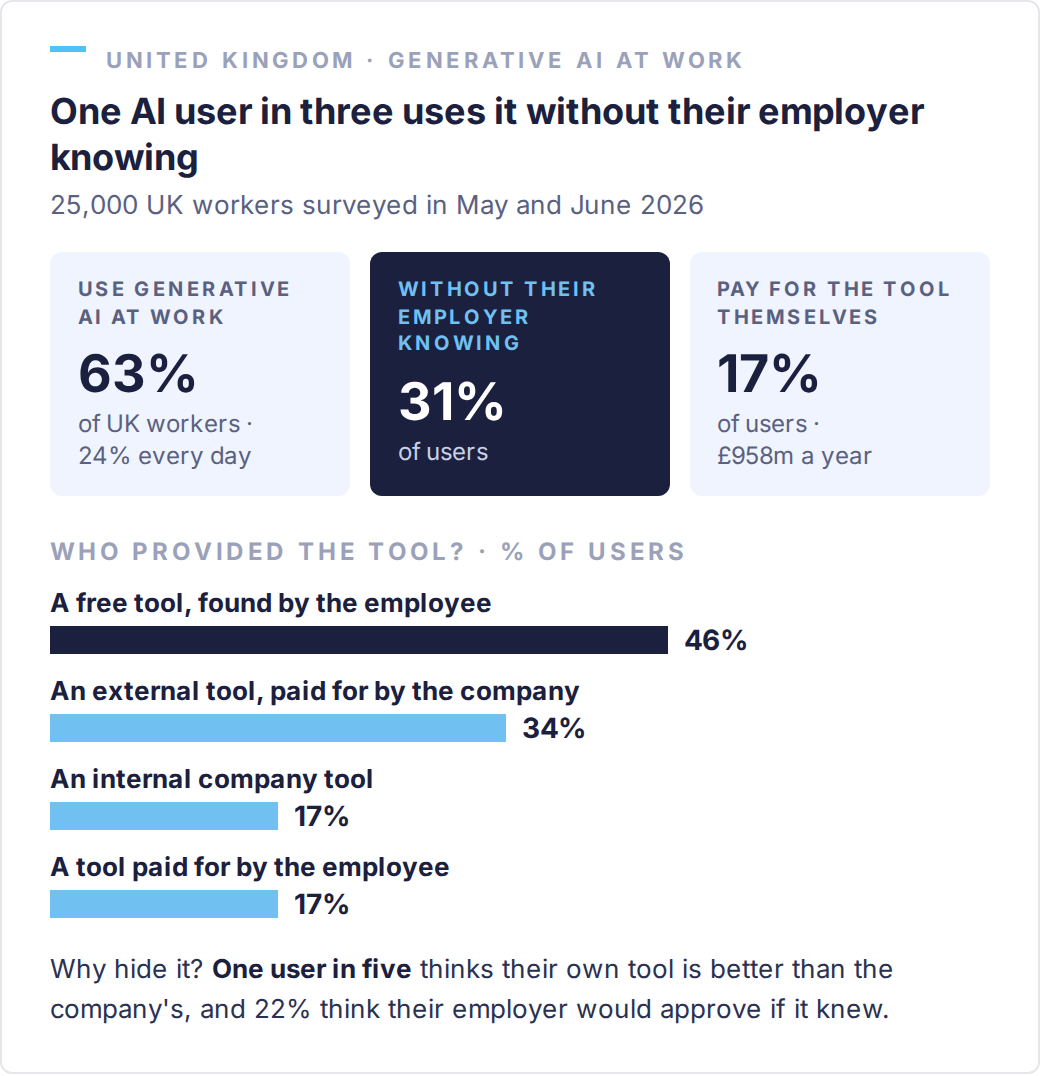
Deloitte surveyed 25,000 UK workers aged 18 to 70, employees and self-employed, between 7 May and 10 June 2026. 63% use generative AI for their work, 24% every day. Among these users, 31% do so without their employer knowing, and 17% pay for at least one tool out of their own pocket: £958 million a year across the country, according to Deloitte's estimate.
The breakdown by tool explains why. 46% of users rely on free tools, 34% on external tools paid for by their employer, 17% on internal tools. In other words, the company has provided a tool to fewer than one user in two; the others found their own. Half have received no formal training, 65% feel that their executives give no clear guidance on the use of AI, and 64% of weekly users fear that their manager will conclude that AI can do their job.
France is no different. In February 2026, 61% of French employees using AI relied on a consumer tool that their company had not provided, against 19% using a tool it had provided (KPMG France / ViaVoice, 1,000 private-sector employees). And 28% of working people who use AI rely on their own tools without necessarily telling their employer (Ipsos for Jedha, 2025). Hidden use is not the employees' fault: it is a sign that the company has not provided the tools.
Sources: Deloitte UK, GenAI Workforce Survey 2026, 25,000 workers aged 18 to 70, representative sample, fieldwork by Ipsos UK from 7 May to 10 June 2026, published 16 September 2026. Self-reported. Reliability: B. · KPMG France / ViaVoice, Observatoire de l'IA responsable en entreprise 2026 (2026 responsible AI in business observatory), 1,000 private-sector employees, February 2026. Reliability: B. · Ipsos for Jedha, 1,000 working people, May to June 2025. Reliability: B.
The more people use AI, the more they use it outside their own job
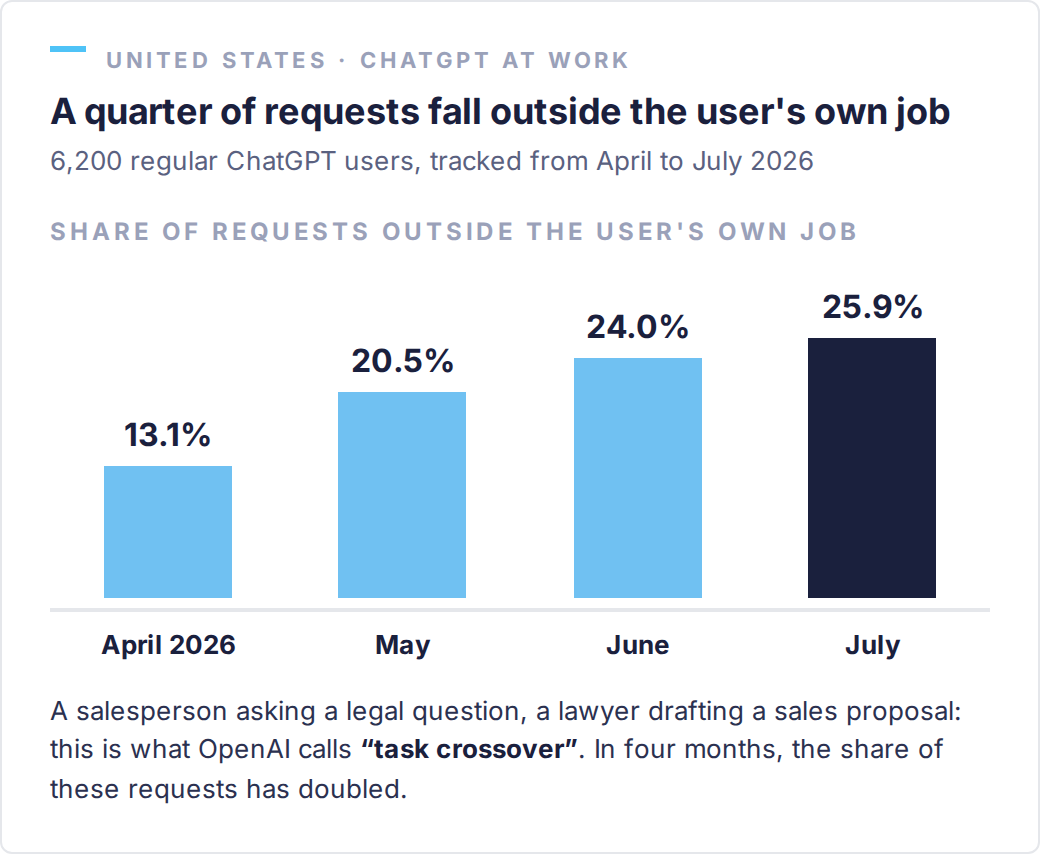
OpenAI analysed more than 1.5 million work messages sent on ChatGPT by US users between April and July 2026, matching each message against the tasks of the user's stated occupation. Some requests fall within that occupation; others concern the tasks of a different one: a salesperson asking a legal question, a lawyer drafting a sales proposal. OpenAI calls this “task crossover”.
Among the roughly 6,200 users tracked over the four months, the share of tasks from outside their occupation, once tried, keeps growing: 13.1% of their job-related requests in April, 20.5% in May, 24.0% in June, 25.9% in July. A user who did a task from outside their occupation in a given month does it again the following month in 23.6% of cases, against 8.4% for a comparable user who had not done it. These requests are worded differently: shorter by 20 characters on average, with fewer requests for explanations and more requests to check. Users borrow the expertise; they do not learn it.
Not every task becomes a habit. Talking about products with a client (54% repeated the following month), writing an advert (44%) or marketing material (37%) become habits; explaining financial information (15%) or doing legal research (10%) remain occasional. One caveat: these are frequent users with a ChatGPT Business account; they do not represent the US workforce as a whole.
Source: OpenAI Economic Research, “Work at the Frontier: How workers are unlocking new ways of working”, 16 September 2026, more than 1.5 million work-related ChatGPT messages from US users, April to July 2026, occupations based on the O*NET classification; usage data from a software vendor, non-representative sample. Reliability: B.
This is the share of summer associates at US law firms (students on a summer internship) who used AI during their internship in 2026. In 2025, the figure was 80% (Law360 Pulse, 486 interns surveyed between 1 July and 18 August 2026). In firms with more than 1,000 lawyers, it is 99%. 87% say their firm encouraged them to use it, 9% that it was mandatory, 1% that it was discouraged or forbidden. 97% of those who used AI did so for legal research and analysis, and fewer than one intern in five is worried about their professional future. Law, a profession built on text, now trains its juniors with AI from the internship onwards.
Company agreements on AI are doubling every year
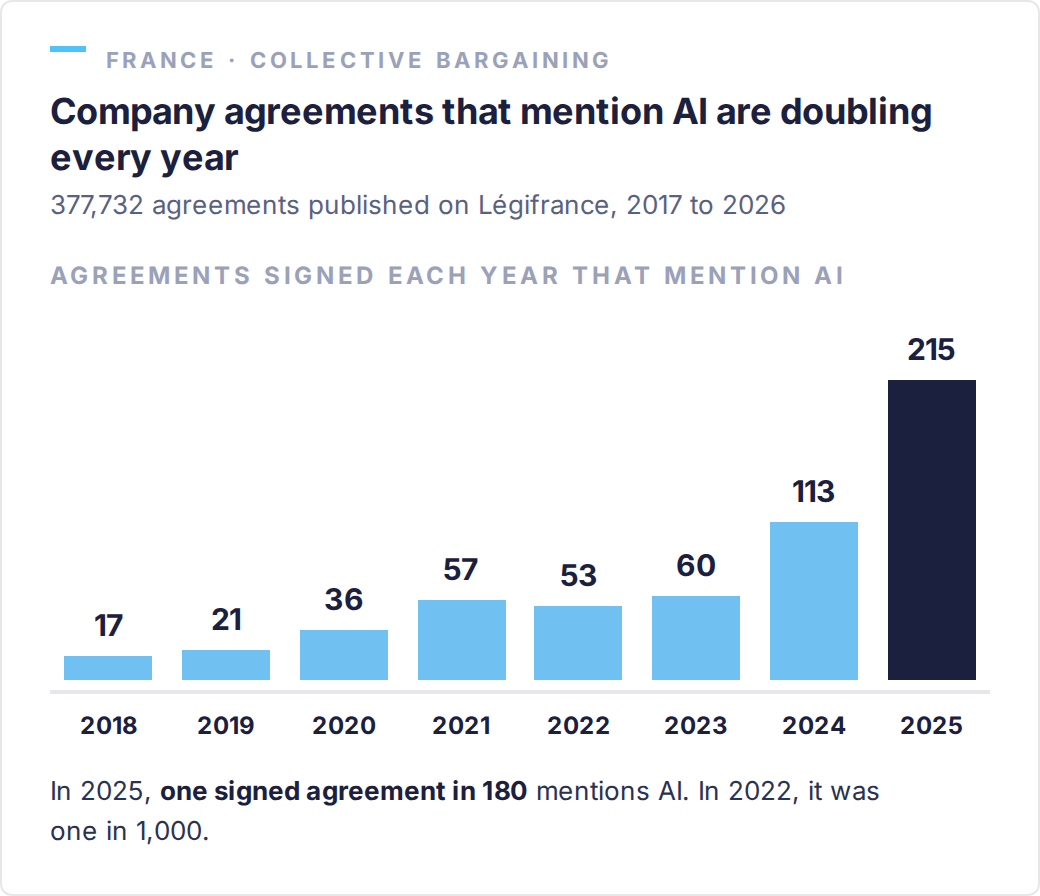
Three researchers at the Centre d'études de l'emploi et du travail (CEET), the Cnam's research centre on employment and work, went through the 377,732 company-level collective agreements published on Légifrance, the French government's legal database, between September 2017 and February 2026. 593 mention artificial intelligence: just over one agreement in a thousand over the period. But the curve has become steeper. About fifty agreements a year between 2021 and 2023, about 115 in 2024, about 215 in 2025: the number has doubled every year since ChatGPT, while the total number of agreements signed is falling, from 52,000 in 2022 to fewer than 39,000 in 2025. As a share of the total, that is one agreement in a thousand in 2022 and one in 180 in 2025.
What these agreements say has changed too. Before 2020, AI appears in lists, next to big data and robotics, in workforce and skills planning agreements (GPEC) signed by large companies in information, finance and industry. During the pandemic (133 agreements between 2020 and 2022, nearly three times the previous period), it comes in through remote working and the monitoring of employees working at a distance. Since 2023, it has become a subject in its own right: 82% of the occurrences of the phrase “artificial intelligence” date from after the launch of ChatGPT, and procedural agreements set out a step-by-step regulation of AI use, such as the AI follow-up committee created at AXA France in November 2024.
The lens is still employment: 40% of the agreements mentioning AI deal with jobs and skills (GEPP-GPEC), against 5% of all agreements, and actual working conditions remain largely absent. The information sector accounts for 18% of AI agreements, against 4% of all agreements; finance for 15%, against 6%.
Source: N. Greenan, S. Napolitano, J. Pillosio, “Négocier l'intelligence artificielle?” (Negotiating artificial intelligence?), CEET (Cnam), working paper no. 220, September 2026; 377,732 agreements published on Légifrance from 1 September 2017 to 24 February 2026, text mining; annual values read from figure 1, rounded; not all agreements signed at the end of 2025 have been published yet. Reliability: A.
- 01One AI user in three hides it from their employer, one in six pays for the tool themselves. When the company provides no tool, no rules and no training, people use AI anyway, without the company. Providing the tool is the first way to see what employees do with it.
- 02AI is widening jobs from the inside. In four months, the share of tasks from outside the user's occupation doubles among regular users, and it is sales tasks that become habits. For an HR director, the job description changes before the organisation chart does.
- 03AI has entered collective bargaining through jobs and skills, and the number of agreements doubles every year. One agreement in 180 in 2025 is still a small share; but an HR director who negotiates in 2026 without an AI clause will soon fall behind their peers.
Get the weekly letter
Every week: the data signals that matter, the number of the week, and what we measure among our clients. Free, no advertising. The letter is sent in French; every issue is also published in English on this site.
One letter a week, on Sunday, written in French. Unsubscribe in one click, at any time.