

Women now use AI as much as men
English edition. The weekly letter itself is sent by email in French.
In the United States, women caught up with men in two years; among our clients, they have even overtaken them. Also this week: AI spending per employee up fivefold in three years, and France now the world's third-largest Claude user.
AI spending per employee has risen fivefold in three years, led by small companies
Ramp is an American corporate card and payments platform. Its team of economists publishes the Ramp AI Index every month, built on the actual spending of more than 70,000 US companies: subscriptions to models and coding agents, API tokens, GPU cloud. In August 2026, the median company spends $23.23 per employee per month on AI when it is small, $9.32 when it is mid-sized, $3.68 when it is large. In September 2023, the figures were $5, $1.78 and $0.49.
The rise is across the board and it is speeding up. Over the past twelve months, spending per employee has more than doubled in all three categories: +132% for small companies, +143% for mid-sized ones, +207% for large ones. Small companies saw the biggest rise in dollar terms, +$18 per employee per month, and the gap with large companies has widened: $4.50 in September 2023, almost $20 today.
A median, not an average: half of companies spend more, the other half less. At $23 per employee, when a subscription costs $20 to $25 a month, the median small company buys roughly one seat for every two employees. This is an order of magnitude, not a measurement: the spending also includes API and GPU. In large companies, $3.68 per employee means one seat for every ten: there, AI is still reserved for a minority, or bought at volume prices.
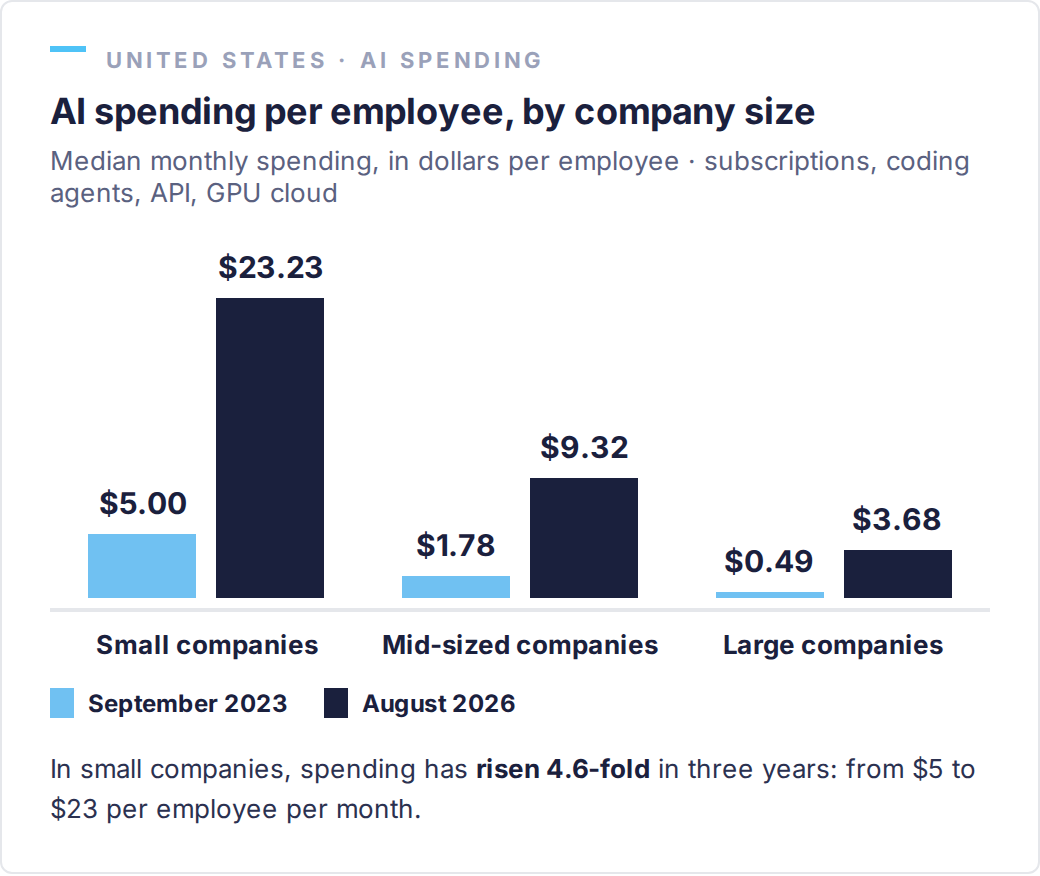
Source: Ramp AI Index, August 2026, Ramp Economics Lab, payment data (cards, invoices) from more than 70,000 US companies that are Ramp customers, September 2023 to August 2026. Reliability: B (a vendor's panel).
Women have caught up with men in chatbot use, especially on ChatGPT
In the United States, 49% of adults had used an AI chatbot by February 2026, up from 33% in 2024 (Pew Research Center, 5,119 adults). In two years, the gap between men and women has narrowed from 11 points, 39% versus 28%, to 3 points, 50% versus 47%. On daily use, a gap remains: 27% of men, 20% of women.
The breakdown by tool sharpens the picture. On ChatGPT, the most widely used tool, men and women are exactly level: 44% of men, 44% of women. On Meta AI, women are ahead, 15% versus 13%. The gap persists on the other, less widespread tools: Gemini 29% versus 20%, Copilot 22% versus 13%, Grok 11% versus 4%, Claude 9% versus 4%.
What has not converged is the perceived benefit: 35% of men say chatbots help them be more productive, compared with 25% of women. With almost equal use, women report less gain.
What we see among our clients. On the Mister IA Panel, the intensity of Claude use, in messages per active user, was slightly lower for women in March (−3%), equal in April, lower in May (−5%). Women moved ahead in June (+13%), July (+26%) and August (+12%).
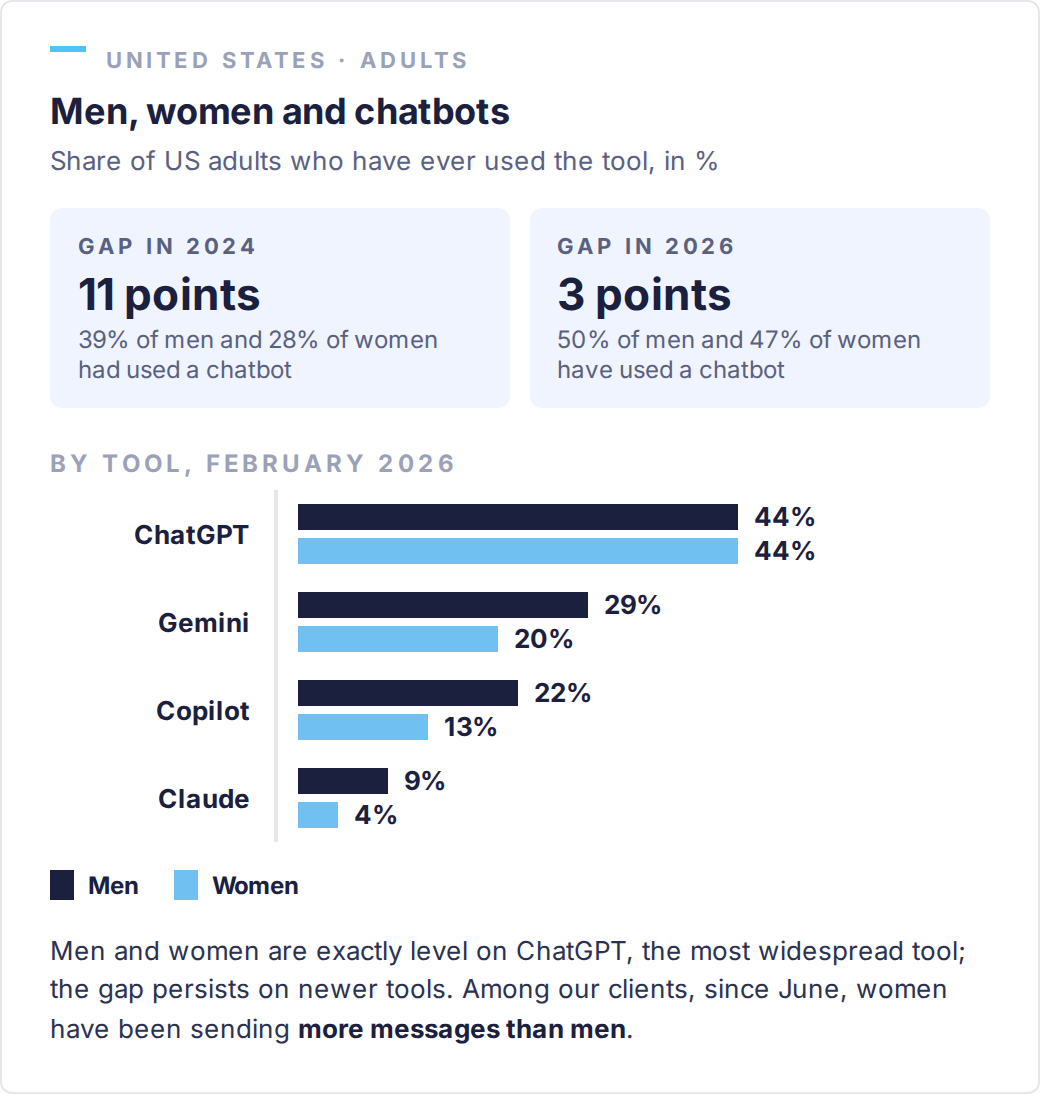
Sources: Pew Research Center, “The gender gap in AI”, 17 June 2026, American Trends Panel, 5,119 US adults surveyed from 17 to 23 February 2026. Self-reported data. Reliability: A. · Mister IA Panel, Claude messages per active user, men and women, March to August 2026, measured data, aggregated and anonymised.
That is the average length of a message sent to Claude by users of the Mister IA Panel in July 2026, about forty words. March: 209 characters, April: 194, May: 204, June: 220, July: 235, +12% in four months. A longer message means more context: what is being asked, for whom, in what form. Users are learning to brief AI, and that is the first component of our quality score.
France has become the world's third-largest Claude user, but one message in two is personal
Alongside its Economic Index, Anthropic publishes real usage data from Claude.ai, automatically classified by country and by type of task, in open access. In August 2025, France accounted for 2.2% of global usage and ranked eighth. In November, 3.0%, sixth; in February 2026, 3.2%, fourth; in April, 3.6%; in May 2026, 3.95%, third in the world behind the United States (20.2%) and India (7.1%), ahead of the United Kingdom (3.5%). Relative to its working-age population, France uses Claude 3.97 times more than its share of the world population would suggest; the United States stands at 3.87.
The caveat is in how that usage breaks down. In France, in May 2026, 48% of conversations are personal, 34% are work and 18% are study. Worldwide: 40% personal, 46% work, 16% study. The work share in France even fell, from 39% in April to 34% in May. These figures cover only Claude.ai, on the Free, Pro and Max plans: business use through the API, 84% of which is work-related, is not included.
What this means for a CIO: the tool is already in employees' hands, and it arrived at home before the office. France is ahead on individual adoption and behind on managed use at work, which is the very definition of shadow AI. It is also an opportunity: these users have already learned from their personal use, and now need to be equipped and given clear rules.
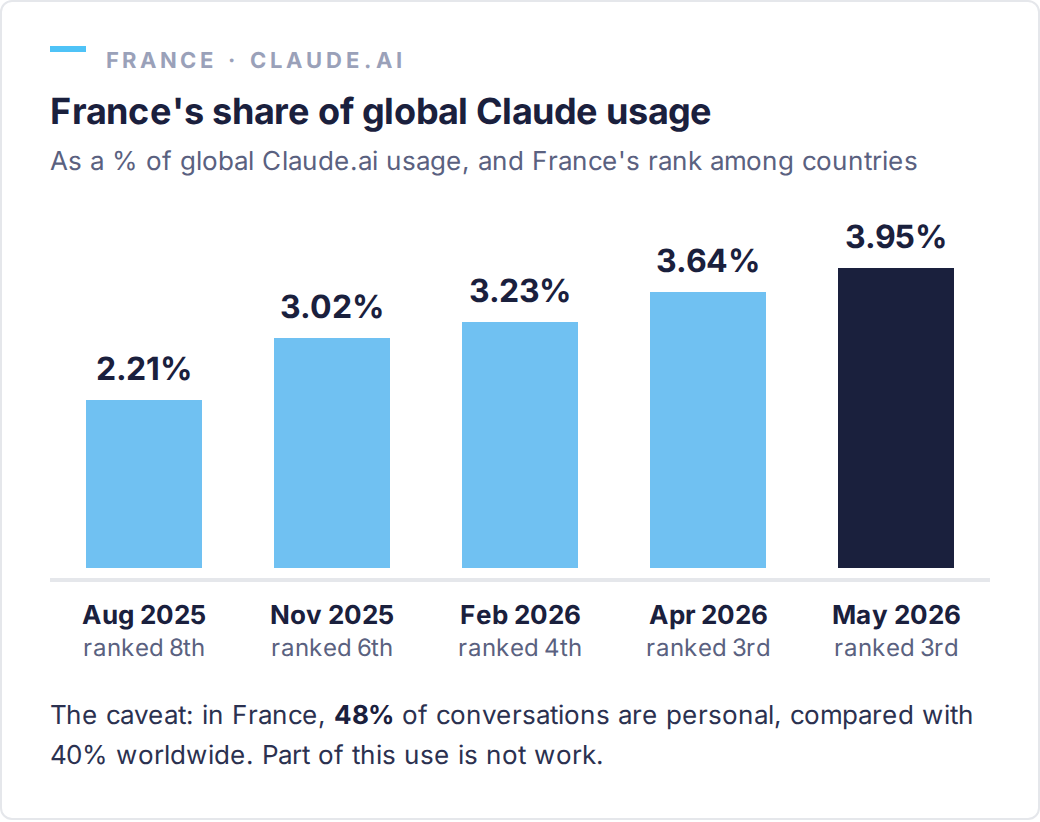
Source: Anthropic Economic Index, Hugging Face datasets, releases of 15 September 2025, 15 January, 24 March and 26 June 2026; Claude.ai use (Free, Pro, Max), excluding the API; shares of total usage, including unattributed usage. Reliability: A.
- 01$23 per employee per month in the median small US company is roughly one subscription for every two employees. In large companies, $3.68: one for every ten. AI is bought first where the decision chain is short.
- 02The access gap has closed in two years; the gap in perceived benefit has not: 35% of men say they are more productive, 25% of women. Among our clients, women now send more messages than men. An HR director's job is to make sure the gain is recognised, not just to open up access.
- 03France accounts for almost 4% of global Claude.ai usage, third behind the United States and India, with higher use per head than the Americans. But one message in two is personal: AI arrived at home before it arrived at the office.
Get the weekly letter
Every week: the data signals that matter, the number of the week, and what we measure among our clients. Free, no advertising. The letter is sent in French; every issue is also published in English on this site.
One letter a week, on Sunday, written in French. Unsubscribe in one click, at any time.