

Automate, augment, and also expand
English edition. The weekly letter itself is sent by email in French.
There is a lot of talk about automating tasks and augmenting employees. A German experiment shows a third effect: with AI, apprentices succeed at tasks beyond their training. Also this week: half of all Slack messages come from apps and agents; 50% of French people use AI for their health; 86% of French lawyers have an AI tool, but 3% at most let it work on its own; and does Claude hide your card number from its model?
With AI, IT apprentices succeed at the tasks of junior engineers
AI is usually described in two ways: it automates tasks, or it augments employees, who do the same work faster. A German experiment shows a third effect: it expands what people can do. Economists from the ifo Institute, Stanford and Germany's Federal Institute for Vocational Education and Training brought together 673 final-year IT apprentices at twelve vocational schools in six German states. Assigned at random, some had ChatGPT, the others worked without internet access, as in an exam.
Each apprentice completed three 20-minute tasks: one from the final exam curriculum, and two deliberately beyond it, at the level of a first job as an engineer, which usually requires a university degree. On these tasks beyond the curriculum, AI raises the success rate by 26 to 31 points. The clearest case is a machine learning task that only 3% of apprentices consider related to their training. Without AI, they score 4% of the points; with ChatGPT, 58%.
This gain does not come at the expense of understanding: when questioned right afterwards without AI, those who had used it answered better, by 4 to 10 points. And those who already knew how to use AI benefited more.
For employers, the consequence is concrete: with AI, a technician can take on part of the work so far given to an engineer, provided they have learned to use it and someone checks the result. A word of caution: these are short tasks in a classroom, not a real job, and the working paper has not yet been peer reviewed.
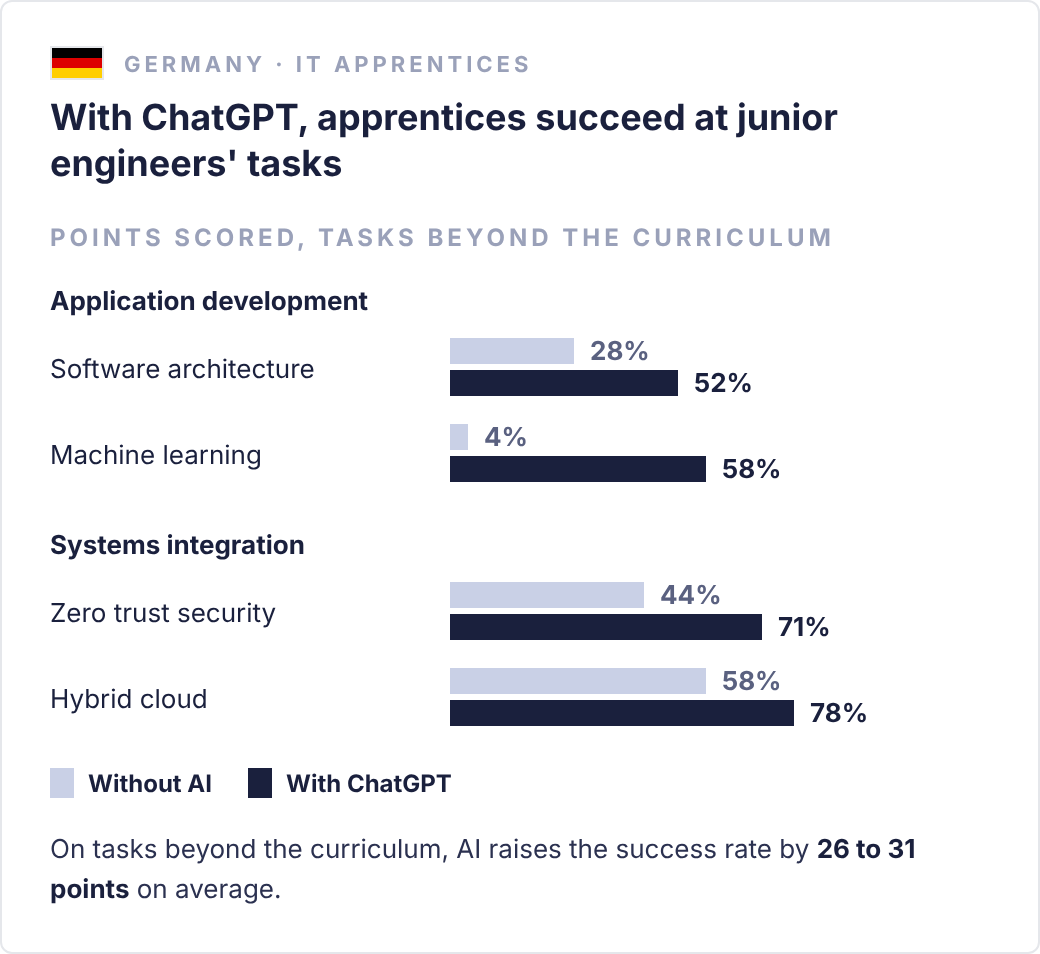
Source: H. Brosch, C. Langer, P. Lergetporer, S. Mueller, H. Pfeifer and N. Tschoepe, “Task Expansion with Generative AI: Experimental Evidence on Middle-Skilled, Early-Career Workers”, CESifo Working Paper 13045, October 2026; preregistered randomised experiment, 673 final-year IT apprentices, 12 vocational schools, 6 German states, October 2025 to January 2026; ChatGPT Pro versus no internet access; 20-minute tasks scored with a marking scheme; “with ChatGPT” = mean without AI + estimated effect (table A.4). Working paper, not peer reviewed. Measured. Reliability: B+.
Who still writes in Slack? Half of all messages come from apps and agents
On 3 November, Salesforce, which owns Slack, published a first-of-its-kind figure: 50% of messages sent in Slack now come from apps and agents rather than humans, out of about a billion messages a day. Note that “apps” also covers ordinary notifications, such as a ticket being created or a payment received. And Salesforce gives neither its method nor a comparison with last year.
Even so, the share of agents is growing fast. The actions they trigger from Slack to read or change data in other tools (MCP tool calls) have reached 127 million a week and double every quarter. At Anthropic, 65% of code changes go through Slack; at Salesforce, 83% of employees use the Slackbot assistant every week.
This is a heavy use at Mister IA too, and we have made it a management indicator. We track the share of Slack messages written by an agent, and the share of tasks in our CRM, HubSpot, created by an AI agent rather than by an employee. These figures show better than a number of licences how far work has really changed.
This kind of measure will become an indicator to track in companies: it can be calculated from the logs of Slack, Teams or the CRM, with no survey. The challenge is to separate simple notifications from messages actually written by an agent, otherwise the figure flatters.
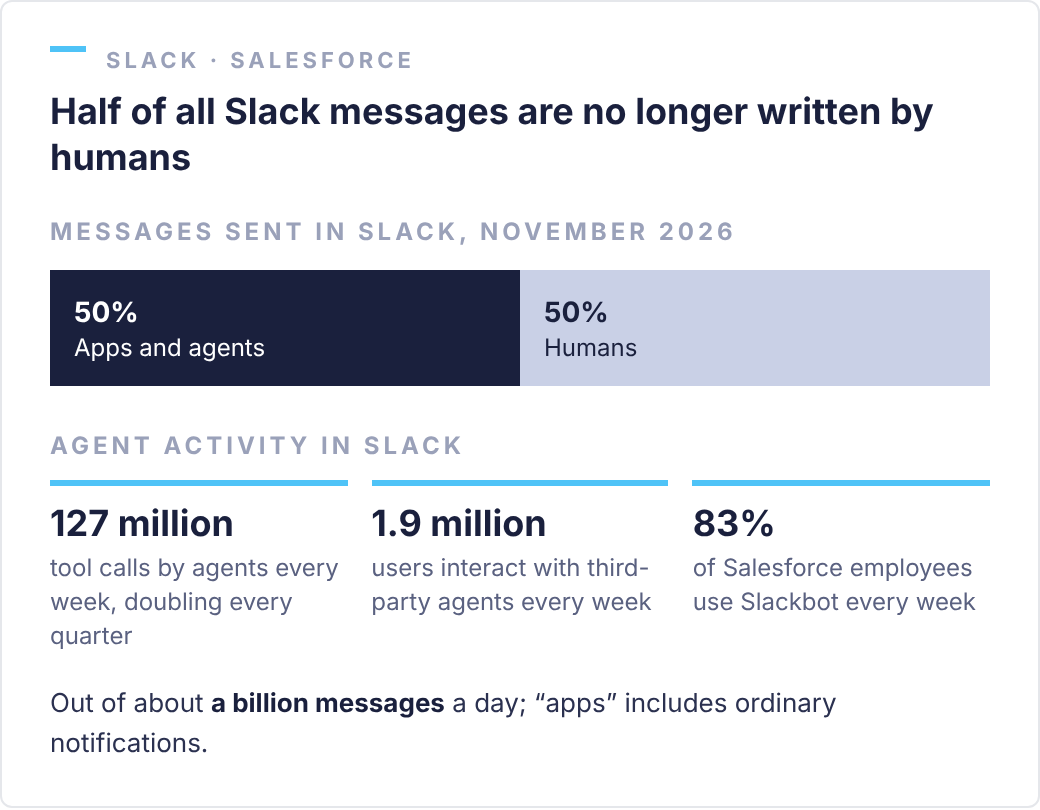
Source: Salesforce, “Slack stats” (Slack key figures page), 3 November 2026; platform usage data, period and method not published; “apps and agents” includes ordinary integrations; figures published by the vendor. Reliability: B-.
50% of French people use AI for their health, 5 points more than a year ago, according to the 2nd Data & AI in Health Barometer (Acsel and Toluna, 1,029 French people surveyed in July 2026). “AI” is taken in a broad sense: only 29% of French people use a generative AI tool such as ChatGPT, Claude or Mistral. Healthcare workers are following: 91% use AI, and 43% every day, up from 32% a year ago. But the relationship is changing: 38% have seen a patient challenge their diagnosis after an exchange with AI, and 83% of French people want to know if their practitioner uses it.
More and more AI among lawyers, but almost never on autopilot
French lawyers have equipped themselves fast. According to the first AI usage barometer of the Conseil national des barreaux, the national bar council, carried out by OpinionWay among 2,281 lawyers in September, 86% have at least one AI tool at their firm. 92% use it to check the state of the law, and time saving is the main benefit cited (84%).
But they keep control. 58% delegate at least one task to AI, mostly to get a first draft that they review and rework. Fully autonomous delegation, where AI does the work alone, never exceeds 3%. The risk of error, the GDPR and professional secrecy remain the main concerns.
In-house legal departments go further in how they organise work. According to the 2026 survey of the Association of Corporate Counsel, nearly 90% of European legal teams use AI for routine tasks, and 31% are moving their juniors to advisory and judgement work as AI takes over repetitive work. 30% even have AI check their law firms' invoices.
This is where the expansion happens: juniors take on senior work earlier. That still means tracking what they can do: 43% of these teams do not assess their lawyers' AI skills. A word of caution: these surveys are self-reported, and the European part of the ACC survey is known only from its press release.
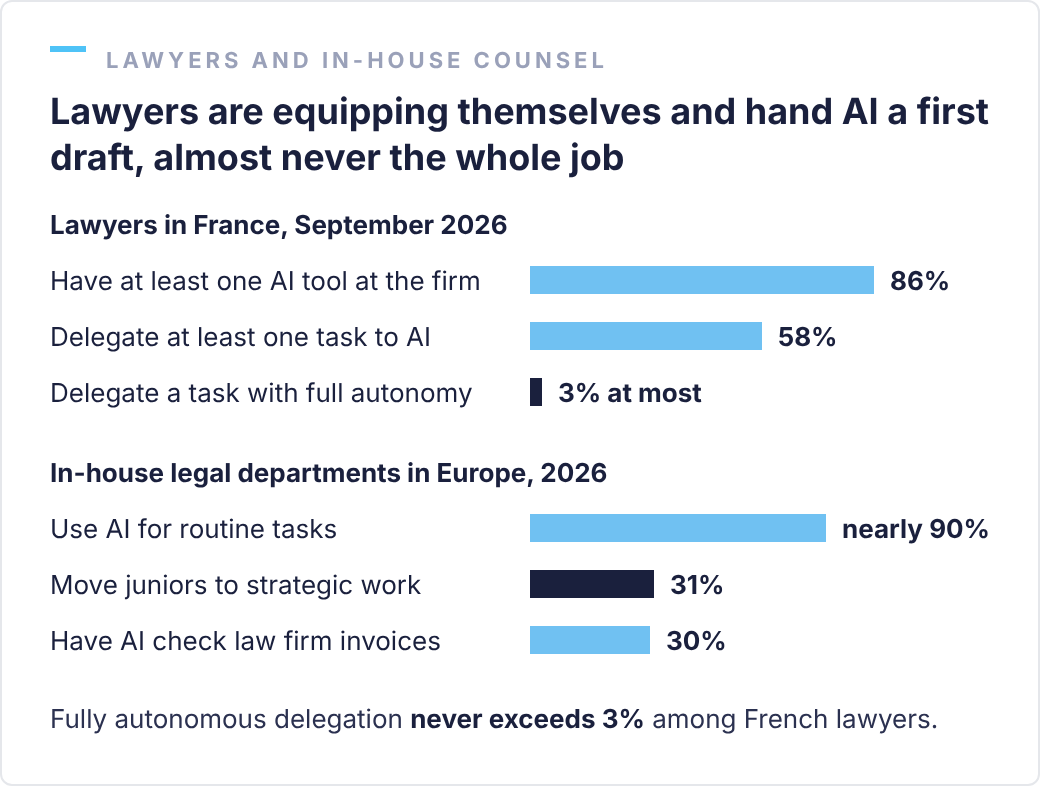
Sources: Conseil national des barreaux (Observatoire de la profession) and OpinionWay, “Baromètre des usages de l'IA dans la profession d'avocat” (barometer of AI use in the legal profession), 1st edition, 6 November 2026; 2,281 lawyers, September 2026; collection method and weighting not specified on the page. Self-reported. Reliability: B. · Association of Corporate Counsel, “2026 Generative AI Survey”, European results (press release), 3 November 2026; in-house legal departments; European sample size not published (576 respondents worldwide, according to The Indiana Lawyer). Self-reported. Reliability: B-.
Does Claude spot my sensitive data so it is not sent to its model?
Not in an ordinary conversation: everything you type or upload into Claude is sent to the model, card number included. The idea comes from Claude Duet, the personal agent Anthropic has been testing in the United States since 21 October, with a waiting list, which acts on its own in a remote browser: it reads your emails, replies, books. For this agent, Anthropic has built in safeguards. Passwords never go through the model: entered in a separate form and encrypted, they go straight to the browser. Purchases are made with a single-use virtual card, limited to one merchant and one amount: your real card number is shared with neither the agent nor the merchant.
Finally, a classifier separate from the model checks every message the agent is about to send. Credentials, full card or account numbers and ID numbers are never sent, even if you ask; health and financial information only with your consent. Anthropic acknowledges that these filters can still let sensitive data through.
Source: Anthropic, “Claude Duet: safety, privacy and security”, 23 October 2026; and Claude Duet launch article, 21 October 2026; how it works as described by the vendor, agent in research preview. Reliability: B.
- 01With AI, apprentices succeed at tasks beyond their training without understanding them any less: AI does not just augment skills, it expands them.
- 02Half of all Slack messages come from apps and agents: the share of work produced by agents is becoming an indicator to track, in Slack, Teams or the CRM.
- 0386% of lawyers have an AI tool, but 3% at most let it work on its own; in companies, nearly one European legal department in three already gives its juniors more strategic work.
- ?Claude does not filter what you write to it: only its Duet agent, still in testing, keeps passwords and card numbers away from the model.
Get the weekly letter
Every week: the data signals that matter, the number of the week, and what we measure among our clients. Free, no advertising. The letter is sent in French; every issue is also published in English on this site.
One letter a week, on Sunday, written in French. Unsubscribe in one click, at any time.