

AI can already do 62% of an accountant's work
English edition. The weekly letter itself is sent by email in French.
On 160 month-end close tasks prepared by experienced accountants, the best AI model already meets 62% of the grading criteria, against 56% at the end of July. Also this week: Anthropic employees already credit AI with far more abilities than the American public does; nearly one developer in three spends 4 hours a day with AI; 85.7% of employees in Singapore use it; and ChatGPT no longer necessarily reads everything you can read.
To know what AI will do tomorrow, look at those who use it most today
To anticipate how organisations will use AI tomorrow, the simplest approach is to look at the most advanced ones today. That is what we do every month: we compare the number of messages sent to AI across the more than 10,000 licences we manage for our clients with usage at Mister IA, where we are very heavy users. The gap gives the room for growth. Anthropic, the company behind Claude, applies the same logic: in August, it asked the same questions to 10,980 Americans and 1,334 of its own employees.
The first gap is about today. Can AI already do these tasks as well as a professional? For email management, 86% of Anthropic employees say yes, against 53% of Americans; for bookkeeping, 58% against 41%; for drafting contracts, 52% against 34%. The gap disappears on the hardest tasks, such as publishing a scientific study (25% against 24%): people who work with AI all day mainly see more clearly what it already does in office work.
This gap carries over into expectations. By 2030, 96% of Anthropic employees see AI handling emails alone or with an employee checking, against 66% of Americans; for their own job, AI could do 75% of their current work, against 28% according to Americans in work. And what makes the difference is usage: among Americans who use AI regularly at work, 56% think it will be able to do at least seven of the eight tasks tested by 2030, against 28% of those who have never tried it.
Employees of an AI lab are not neutral. But Anthropic draws a simple conclusion: public expectations will move closer to theirs as usage spreads.
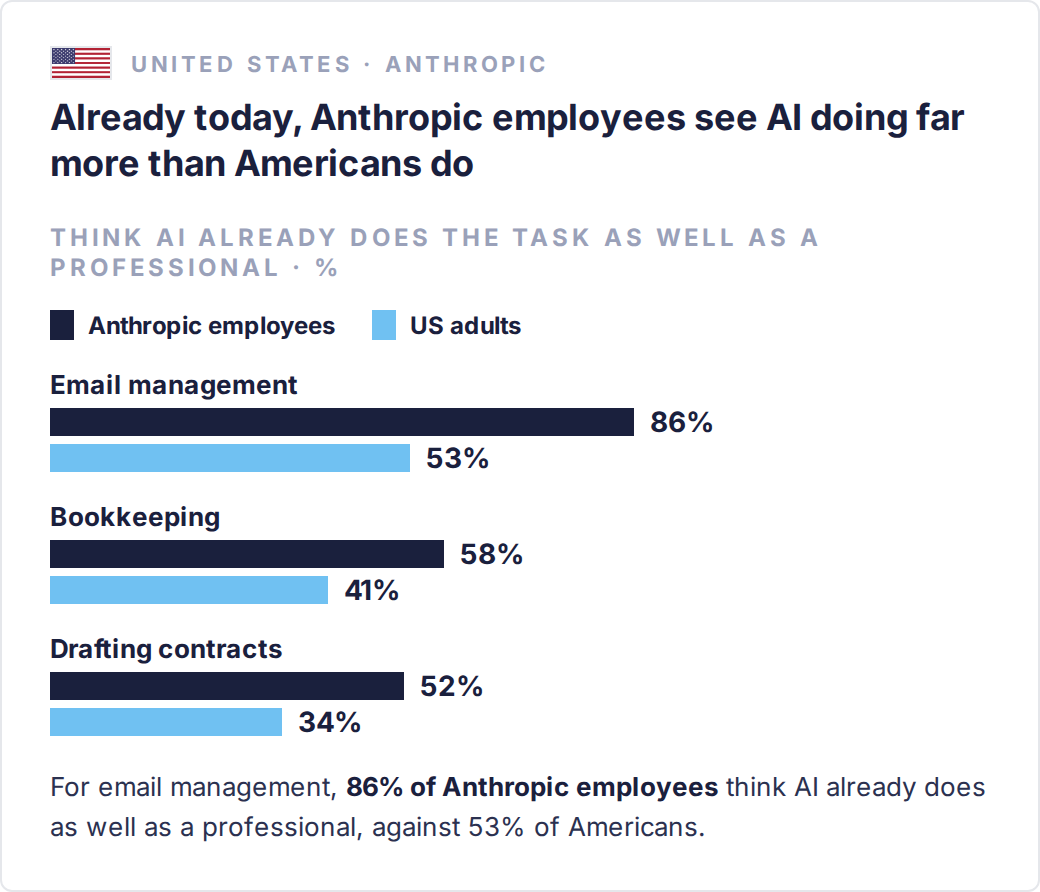
Source: S. Sacher, T. Cotter, C. I. Jones, A. Korinek and P. McCrory (Anthropic Institute), “The AI expectations gap”, 16 October 2026; 10,980 US adults (Morning Consult, weighted online panel, 11 to 23 August 2026, questions about 2030 asked to half of respondents) and 1,334 Anthropic employees (unweighted internal poll, 9 to 12 August 2026); values of figures 1 and 3 read from the report's charts. Self-reported. Reliability: B.
AI can already do 62% of an accountant's work
How can you tell what AI can really do in a given job? By putting it to work and having professionals grade the result. That is the business of Mercor, a San Francisco start-up founded in 2023 and valued at $10 billion, which supplies AI labs with more than 300,000 experts to train and evaluate their models. It publishes APEX, an AI productivity index, job by job. The latest covers accounting, built with Ramp, the American fintech for corporate cards and expense reports.
More than 40 experienced accountants, over half of them Big Four alumni, created ten fictional companies frozen at month-end, with their accounting software, bank statements and invoices, then 160 close tasks: reconciling an account, checking a fixed asset, posting a journal entry. The AI gets a short instruction, with no method, has to find its own documents, and each answer is graded on 14 criteria on average.
The best model, Anthropic's Claude Opus 5.5, meets 61.8% of the criteria, ahead of Claude Fable 5.1 (61.0%) and OpenAI's GPT-6 Astra (57.9%); at the end of July, the best stood at 56.4%. But meeting 62% of the criteria is not completing 62% of the tasks: 58% of the tasks have never been fully solved, by any model. Seven failures in ten come from flawed reasoning: the model spots a discrepancy, then forgets it in the final journal entry. AI already prepares a good part of the close; it does not sign it off yet. Mercor also grades the work of corporate lawyers: we will come back to it in a future letter.
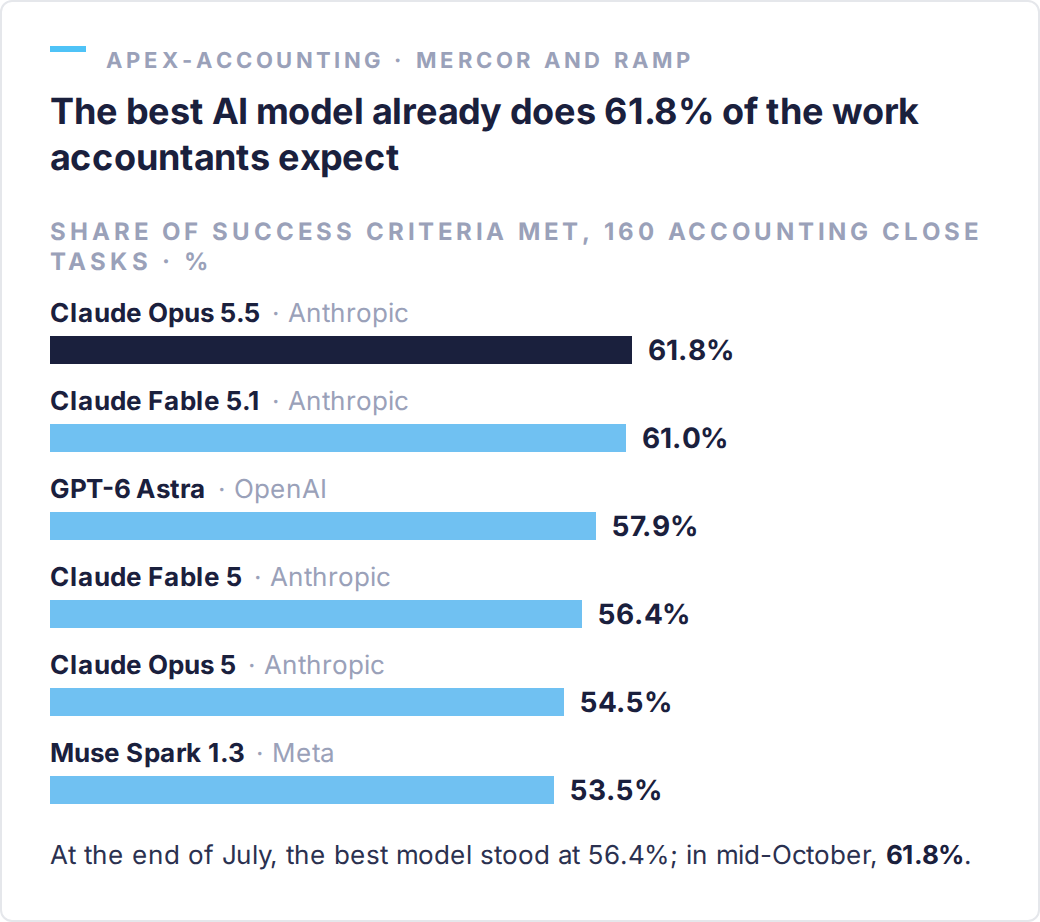
Sources: Mercor and Ramp, APEX-Accounting leaderboard, accessed 18 October 2026; 160 tasks in 10 fictional companies, 2,186 grading criteria written by more than 40 accountants, graded by a judge model that agrees 97% of the time with the experts; mean score over three runs, confidence interval of about ±4 points. Simulated test conditions. Reliability: B. · J. Kern, A. Bennett, R. Stevens, J. Benchek and B. Vidgen (Mercor), “Introducing the AI Productivity Index for Accounting”, 31 July 2026.
In Singapore, where Anthropic has just opened an office, 85.7% of employees surveyed by the Ministry of Digital Development and Information say they use AI at work in 2026, against 77.6% a year earlier. And businesses are following. Singapore ranks fourth, behind Denmark, Finland and Sweden, with nearly twice as many businesses using AI as France. According to the Anthropic Economic Index, it is also second out of 121 countries for Claude usage relative to its population, nearly six times what its size alone would predict. One weak spot: 36.7% of employees took AI training in the past year, while more than two thirds say they need it.
Nearly one developer in three already spends 4 hours or more a day with AI
We measure a lot of the time AI saves, and this letter often reports on it. We measure much less the time we spend with it. The first data are coming in, starting with the heaviest users: developers. Stack Overflow, the go-to question-and-answer site for developers, published its annual survey on 6 October: 30,903 answers from 169 countries, collected from June to August.
Of the 10,926 developers who said how much time they spend with AI, 30.9% spend 4 hours or more a day on it, half a working day, and 80% at least one hour. AI no longer just answers questions: it writes, tests and fixes code with them. Claude Code (66%) and GitHub Copilot (59%) are the most used coding agents.
Among teenagers, it is a different story: according to the first data published by OpenAI on 7 October, they spend on average less than 15 minutes a day on ChatGPT, and fewer than 2% stay on it for more than three hours in a row. Internal figures with no published method, but a sign that time spent is starting to be counted, not just the number of users. A word of caution: the Stack Overflow survey relies on volunteers, and its questionnaire changed this year, so no comparison with 2025 is possible.
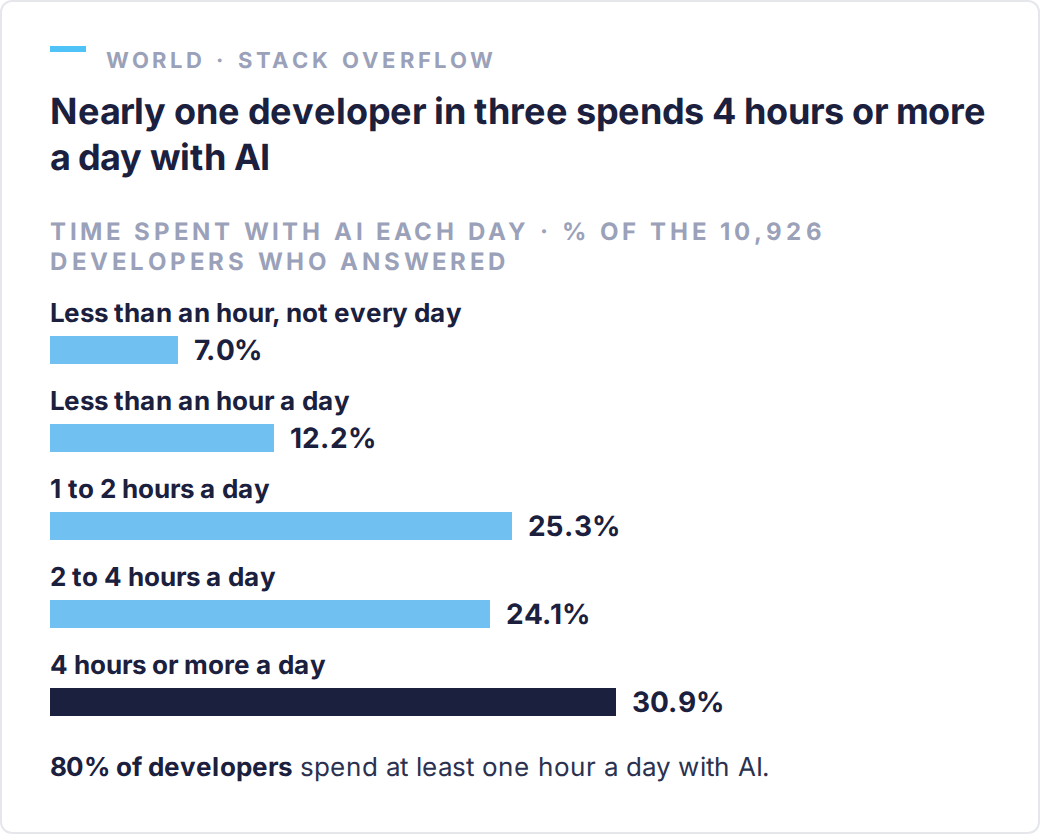
Sources: Stack Overflow, Developer Survey 2026 (AI section), 6 October 2026; 30,903 valid answers from volunteers, 169 countries, 23 June to 5 August 2026; time spent: 10,926 answers. Self-reported, not representative. Reliability: B. · OpenAI, “Helping teens learn, plan, and shape the future of AI”, 7 October 2026; ChatGPT accounts of under-18s, internal figures with no published method or period. Reliability: C.
Can ChatGPT read every document I have access to?
Not necessarily any more. To find a procedure or summarise exchanges, ChatGPT connects to company tools: Google Drive, SharePoint, Teams, Outlook. Until now, in ChatGPT Enterprise, the administrator could have part of the content copied and indexed in advance: the “synced connectors”. OpenAI retired them on 16 October. ChatGPT now queries the tool at the moment of the question, with the permissions of the person asking it.
The change that matters for HR and IT leaders: the company can now go further than those permissions. In the “Safety & Security Controls” settings of each app, the administrator can limit Google Drive to certain shared folders, choose which Teams teams are accessible and exclude from Outlook emails carrying certain Microsoft sensitivity labels. A manager can read an email about an ongoing dismissal; if it carries an excluded label, ChatGPT will not retrieve it, even when asked. The system does not guess what is sensitive: it follows the labels. A new “External access” page also lets admins see and cut off outside applications that use employees' ChatGPT accounts.
Sources: OpenAI Help Center, “ChatGPT Enterprise and Edu release notes”, entries of 16 October 2026 (synced connectors retired, content controls, External access page). · OpenAI Help Center, “Admin controls, security, and compliance in apps”, accessed 18 October 2026.
- 0186% of Anthropic employees think AI already handles emails as well as a professional, against 53% of Americans, and the gap carries over to 2030. The more people use AI today, the more work they expect it to take on tomorrow.
- 02On 160 accounting close tasks, the best AI model meets 62% of the criteria set by experienced accountants, more than five points better than in July. But 58% of the tasks have never been fully solved.
- 03Nearly one developer in three spends 4 hours or more a day with AI, and four in five at least one hour. Teenagers spend on average less than 15 minutes a day on ChatGPT.
- ?In ChatGPT Enterprise, the company can now stop ChatGPT from reading content an employee does have access to, provided it has been labelled.
Get the weekly letter
Every week: the data signals that matter, the number of the week, and what we measure among our clients. Free, no advertising. The letter is sent in French; every issue is also published in English on this site.
One letter a week, on Sunday, written in French. Unsubscribe in one click, at any time.