

The first AI-related burnouts
English edition. The weekly letter itself is sent by email in French.
BCG has measured the mental fatigue caused by AI: 14% of employees who use it have already experienced it, up to 26% in marketing and 19% in HR. Also this week: one business in six pays for an AI subscription according to Qonto, and Claude has overtaken ChatGPT; permanent hiring of young people is falling behind in jobs exposed to AI; nearly one science PhD thesis in three is partly written by AI; and what Microsoft keeps in France with Copilot Cowork.
Qonto index: only one business in six pays for an AI subscription
Qonto, the neobank for freelancers and small businesses, published an index for the first time this week, based on the payments of more than 750,000 customers in France, Germany, Italy and Spain: the share of businesses that pay for at least one subscription to Claude, ChatGPT or Le Chat. In September 2026, that was 16.7% of businesses across the four countries, and 15.8% in France, against 9.0% a year earlier: almost twice as many.
The figure is still low. Many businesses use AI without paying for it, or go through Copilot and Gemini, which the index does not count. Adoption rises with size: in France, 14.4% of businesses with no employees pay for a subscription, 22.2% of those with 1 to 9 employees, and 36.4% of larger ones. Spain (22.6%) and Germany (21.9%) are moving faster than France and Italy (13.0%).
Above all, Claude has overtaken ChatGPT. In June 2026, for the first time, more French businesses paid Anthropic (8.7%) than OpenAI (8.2%); in September, 10.2% against 9.3%. A year ago, only 0.6% paid for Claude. This matches what we see: eight in ten of the licences we manage for our clients are Claude licences. France's Mistral is not taking off: 0.3%.
A word of caution: these figures describe Qonto's customers, mostly freelancers, very small businesses and SMEs, and Qonto warns that its index is not representative of the European market. But these are observed payments, not survey answers: a rare kind of measure.
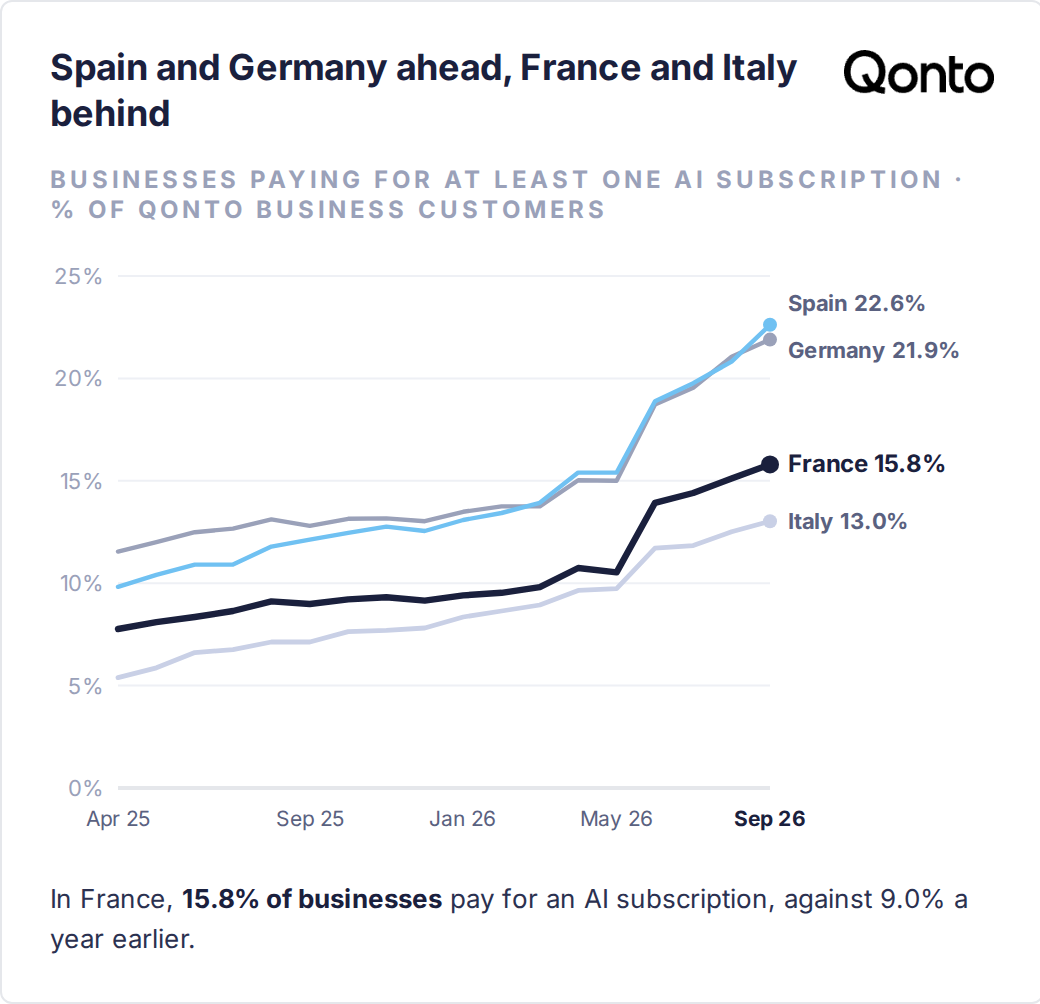
Source: Qonto, AI Adoption Index (Qonto Insights), September 2026 data, read on 10 October 2026; payments by more than 750,000 business customers (freelancers, very small businesses and SMEs) in France, Germany, Italy and Spain; three tools counted (Claude, ChatGPT, Le Chat); monthly chart values read from Qonto's page. Observed payments. Reliability: B.
BCG study: 14% of employees who use AI have already experienced “AI brain fry”
“AI burnouts are arriving in France”, Les Echos reported this week. The phenomenon is starting to be measured: Boston Consulting Group surveyed 1,488 employees of large US companies in January 2026, with the results published in Harvard Business Review. It calls it “AI brain fry”: mental fatigue caused by using or overseeing AI tools beyond what a person can absorb.
14% of employees who use AI say they have already suffered from it: brain fog, headaches, slower decisions. Marketing is the most affected function (26%), ahead of HR (19%); legal is the least affected (6%). What wears people out is above all overseeing the tools: when AI requires a lot of checking, mental fatigue rises by 12%. Beyond three tools used at the same time, perceived productivity falls.
The cost is real: those affected report 39% more major errors, and 34% are thinking of leaving, against 25% of the others.
This is not quite burnout, the authors point out: when AI is used to get rid of repetitive tasks, burnout actually falls by 15%. What protects people: a manager who answers questions about AI (15% less mental fatigue) and not using AI as an excuse to ask for more work (12% more fatigue when employees feel that is the case).
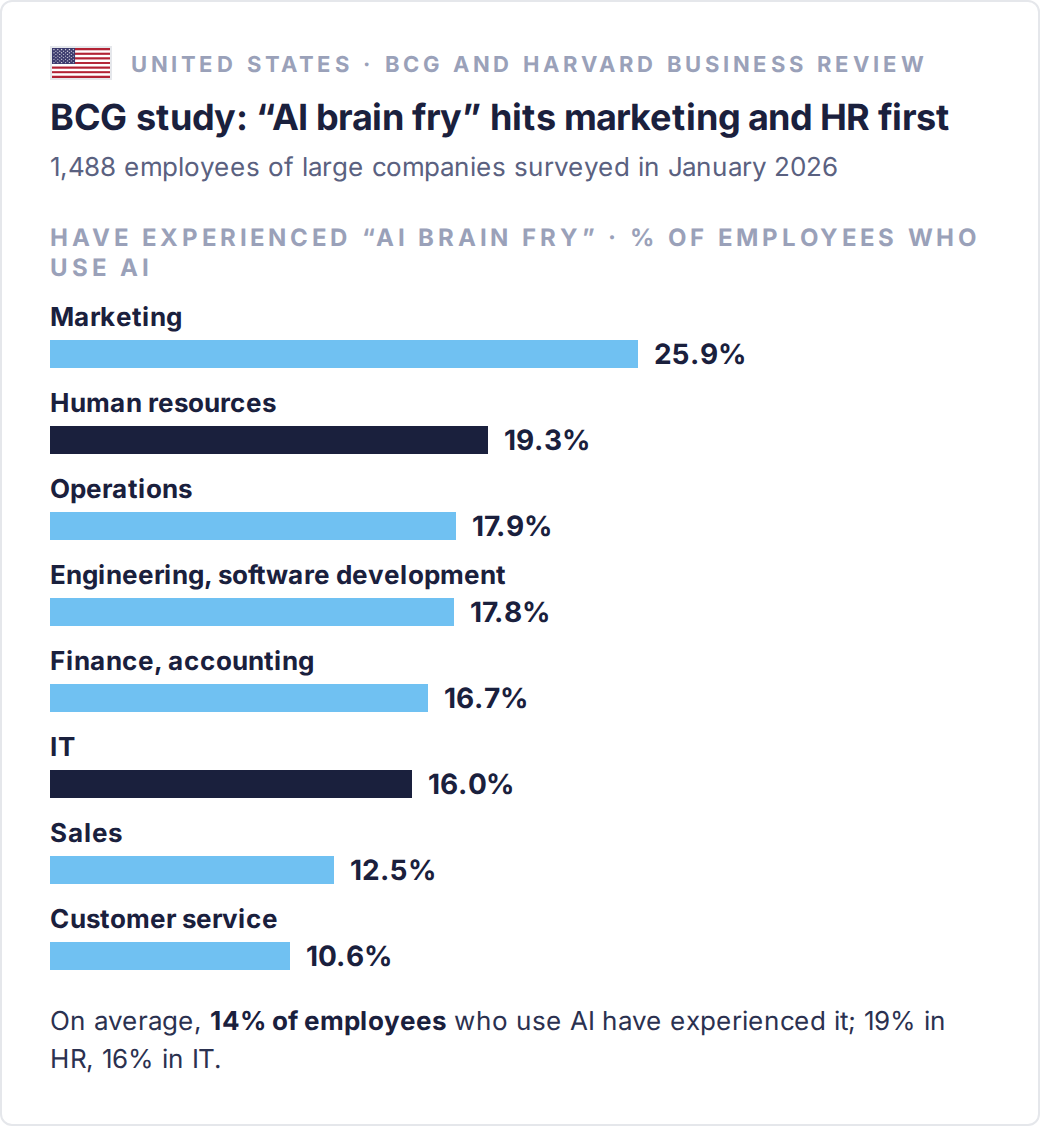
Sources: J. Bedard, M. Kropp, M. Hsu, O. T. Karaman, J. Hawes and G. Rosen Kellerman (BCG), “When Using AI Leads to ‘Brain Fry’”, Harvard Business Review, 5 March 2026; 1,488 full-time employees of large US companies, January 2026. Self-reported. Reliability: B. · Les Echos, “Les burn-out IA débarquent en France” (AI burnouts arrive in France), October 2026.
While the French literary world is torn over a first novel removed from the Goncourt prize selection, suspected of having been largely written by AI (its author denies it), AI has settled into PhD theses: in 2026, 29.4% of science PhD theses defended in the United States have an abstract containing AI-generated text, against 1.7% in 2023. It is 36% in mathematics and computer science, 35% in engineering, and 41% among doctoral students trained in a non-English-speaking country, against 23% for the others: a sign that AI first helps people write in a language that is not their own. The researchers ran the abstracts of nearly 227,000 theses through the Pangram detector; the tool rarely gets it wrong (less than 0.01% false positives), but it tells you who wrote, not who did the thinking.
Since ChatGPT, permanent hiring of young people has dropped in AI-exposed jobs
This is the first measure of its kind for France. Economists from the Banque de France and HEC Paris's LIFT lab tracked permanent hires in the private sector from January 2019 to March 2026, using employers' declarations. They ranked 310 occupations by their exposure to generative AI: for each of the 16,740 skills in the French public employment service's job directory, an AI model assessed whether AI can do it. Translators and journalists are among the most exposed; nurses and care assistants among the least.
The labour market has turned for everyone: unemployment rose from 7.2% at the end of 2022 to 8.3% in the second quarter of 2026, and from 16.9% to 21.6% among 15 to 24-year-olds. But among 21 to 29-year-olds, permanent hires fell by 28.3% in the most exposed jobs between November 2022 and March 2026, against 7.5% in the least exposed. This gap of more than 20 points shrinks to less than 4 points after 50: experience protects.
The starkest case: young software developers, whose permanent hires are 42% below their late-2022 level, against an 11% fall in less exposed jobs. IT does not explain everything: without developers, the gap is still 17 points. And companies that use AI intensively hire fewer young people on permanent contracts, with no clear fall in their total headcount.
The authors remain cautious: higher interest rates, the post-2022 tech correction, remote work and the growth of apprenticeships also play a part. AI is not yet destroying visible numbers of jobs; it is first closing the entry doors. For HR directors, the question becomes: who will train tomorrow's experts if companies stop hiring beginners?
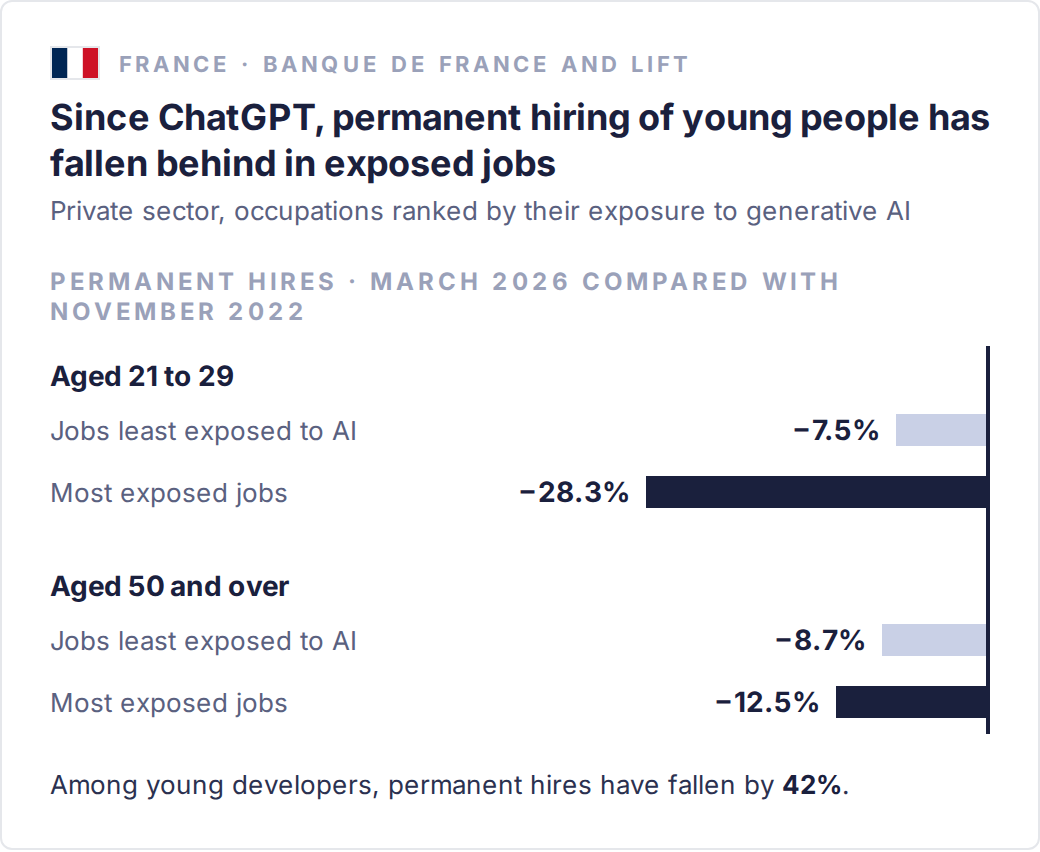
Sources: Banque de France, billet n° 463, “IA générative: les premiers changements du marché du travail sur les jeunes” (Generative AI: the first labour market changes for young people), 8 October 2026; M. G. Palladino, A. Bergeaud, A. Bertheau, S. Bunel and O. Degos. · LIFT (HEC Paris), Policy Paper 2026-02, “IA générative: un gel des embauches de jeunes dans les métiers exposés” (Generative AI: a hiring freeze for young people in exposed jobs), October 2026; private-sector labour movements (Dares), January 2019 to March 2026; Banque de France business survey, about 6,000 firms. Administrative data, exposure estimated by an AI model. Reliability: A-. · Insee, unemployment in the second quarter of 2026, 7 August 2026.
Does Copilot Cowork keep our data in France?
Partly, and only recently. Copilot Cowork, the Microsoft 365 agent that chains tasks across Outlook, Teams, SharePoint and Excel, has been available since June. On 8 October, Microsoft added a written commitment to its documentation: Cowork interactions (prompts and responses) are stored in the customer's country when the default geography of its Microsoft 365 tenant is one of the 15 countries listed, including France. Until then, Microsoft only said that Cowork followed Copilot's rules, with no list of countries.
Two limits. This is a storage commitment, not a processing one: Cowork relies on Anthropic's Claude models, a Microsoft subprocessor, which are excluded from the EU Data Boundary; in Europe they are switched off by default and the administrator turns them on. And working files follow OneDrive and SharePoint rules. Few of our clients with Copilot have opened Cowork, because of its cost, billed by usage on top of the licence, and because of security: the commitment removes part of the objection, not all of it.
Sources: Microsoft Learn, “Data Residency for Microsoft 365 Copilot (including Cowork)”, updated 8 October 2026. · Microsoft Learn, “Anthropic as a subprocessor”, 18 September 2026. · DaKo365, on Microsoft message MC1470878 (in-country data storage, deadline 14 December 2026), 15 September 2026.
- 01Among Qonto's customers, one business in six pays for an AI subscription, almost twice as many as a year ago. Claude overtook ChatGPT in June; Mistral stays at 0.3%.
- 0214% of employees who use AI say they have already experienced “AI brain fry”, mental fatigue caused by AI; 19% in HR. The causes: too many tools to oversee at once, and more work expected.
- 03Since late 2022, permanent hiring of young people has fallen by 28% in the jobs most exposed to AI, against 8% in the least exposed, and by 42% among young developers.
- ?Microsoft now commits to storing its French customers' Copilot Cowork interactions in France, but their processing by Claude models remains outside the EU Data Boundary.
Get the weekly letter
Every week: the data signals that matter, the number of the week, and what we measure among our clients. Free, no advertising. The letter is sent in French; every issue is also published in English on this site.
One letter a week, on Sunday, written in French. Unsubscribe in one click, at any time.