

No, Americans are not the AI champions
English edition. The weekly letter itself is sent by email in French.
In the United States, 22.8% of adults use AI every day: fewer than in the United Kingdom, the Netherlands or China, and fewer than in any other rich country. Also this week: in France, AI is used above all for writing and research, nearly one American user in three saves three hours a week, and 84% of CIOs see employees building agents faster than they can oversee them.
Greenworking study: in France, AI is used above all for writing and research
For Greenworking, Ipsos bva surveyed 1,100 private-sector employees, excluding manual workers, from 12 to 25 May 2026. 73% of them use generative AI at work, ten points more than in 2025. And they use it first of all for writing and research: writing or correcting a text (53% of users), researching a specific topic (47%), translating (43%), summarising a text or data (43%).
These basic uses are still growing: research is up 4 points in a year, summarising 9. For many employees, AI is replacing the search engine and the spellchecker. More advanced uses come next, even though they are growing fast: analysing or structuring data (33%, 8 points more than in 2025), writing spreadsheet formulas (33%), preparing a presentation or a report (23%). Only 18% have already handed several tasks at once to an AI agent.
Employers are catching up: 45% of employees say their company has officially rolled out an AI tool, 9 points more than in 2025. But only 37% of users always stick to authorised tools. Having a tool is not enough: to go beyond text and search, people have to learn how to use it in their own job.
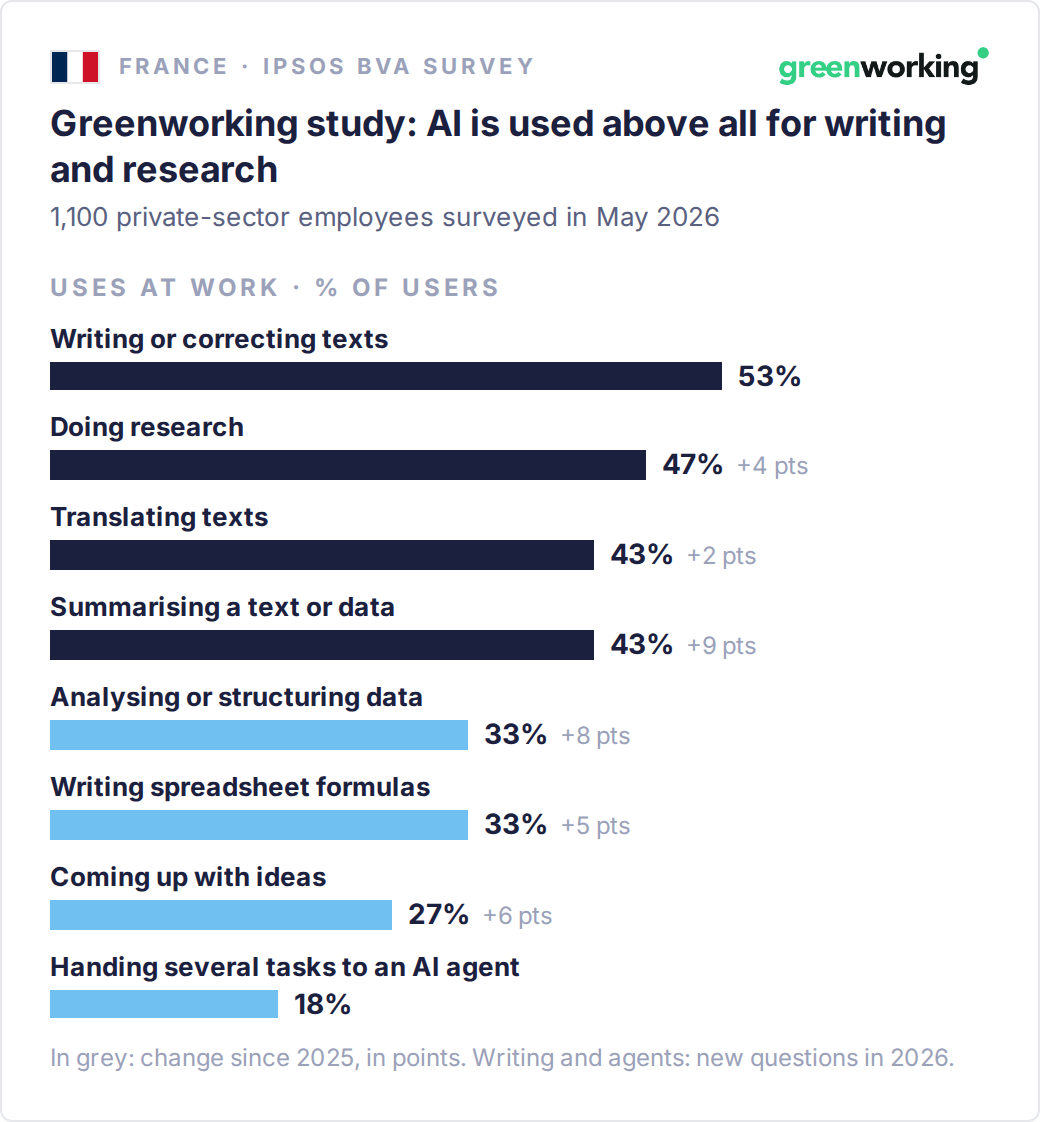
Source: Ipsos bva for Greenworking, Observatoire de l'intelligence artificielle au travail, vague 2 (AI at work observatory, wave 2), published 23 September 2026; 1,100 private-sector employees excluding manual workers (including 474 managers), online, quota sampling, 12 to 25 May 2026; uses as a percentage of the 73% who use AI at work, compared with the May 2025 wave. Self-reported. Reliability: B.
No, Americans are not the AI champions
Gallup, with Microsoft, surveyed around 1,000 people aged 15 and over in each of 37 countries, from April to July 2026, about their use of AI at work or in their personal lives. Singapore comes first: 46% of adults use it every day. Next come Israel (37%) and China (36%). The United States ranks only 14th, with 22.8% daily users, behind the United Kingdom (28.5%), the Netherlands (29.5%) and the Czech Republic (29.7%).
We compared these figures with each country's GDP per capita (World Bank, 2025). The link is clear: the richer a country, the more its people use AI every day. But the United States remains well below what its wealth would predict, which is around 32%. Above all, among rich countries, it is where AI is used least: of the nine countries in the study with GDP above $40,000 per capita, the United States comes last, behind Ireland (24.9%) and the United Kingdom (28.5%). China does the opposite: with $14,000 per capita, it has 35.5% daily users, 14 points more than its wealth would predict.
This does not mean Americans are turning their backs on AI: 68% use it at least once a month, almost as many as in China (70%). But many use it rarely: 23.5% once a month or less, the highest share of the 37 countries. They are also the most worried: 74% of those who know about AI say it worries them, the highest figure in the study.
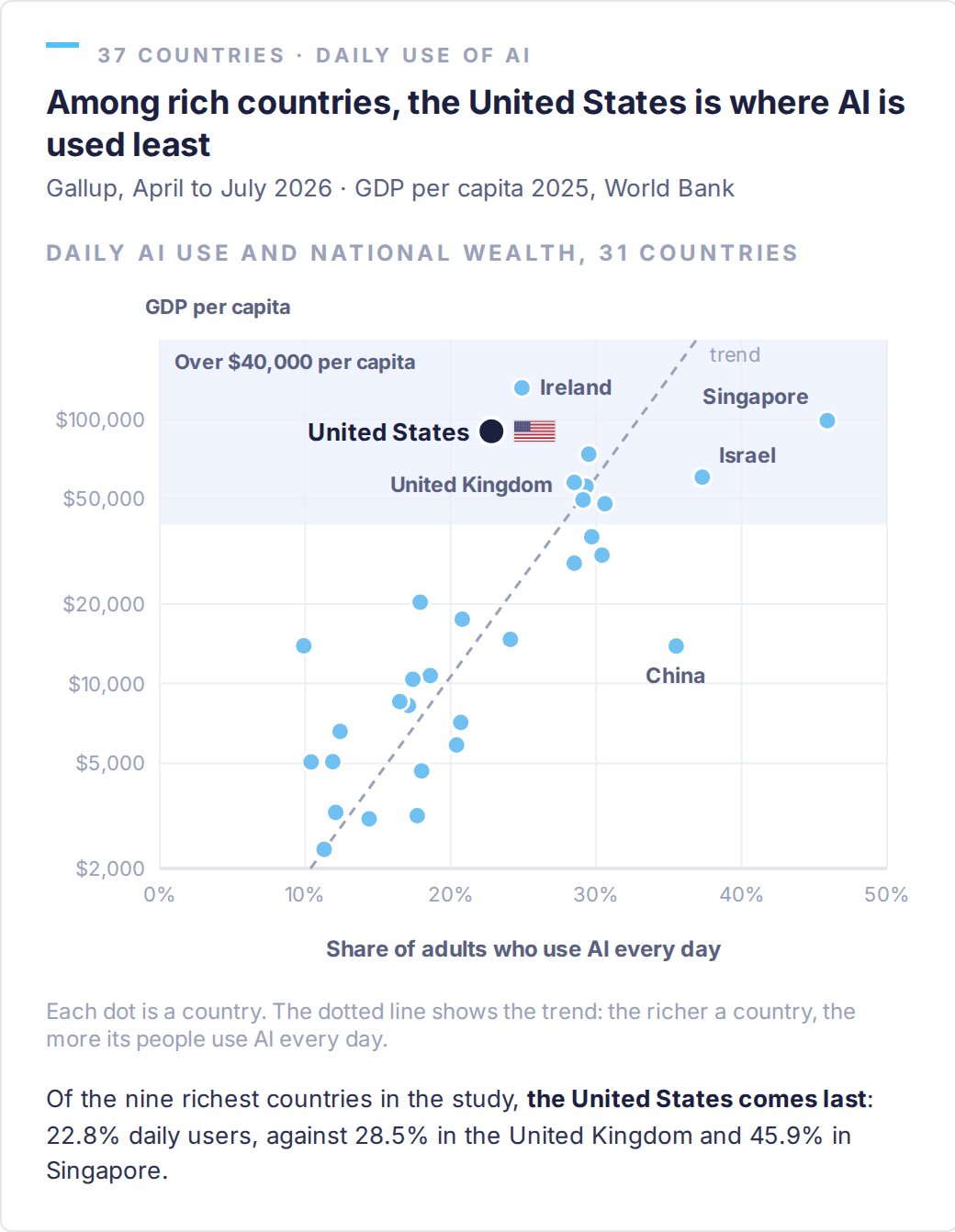
Sources: Gallup with Microsoft, “AI Optimism Globally Widespread Despite Uneven Use”, 22 September 2026; around 1,000 adults aged 15 and over per country, 37 countries, by telephone, face to face or online, April to July 2026; use for work or personal purposes. Reliability: B+. · World Bank, GDP per capita (current US$), 2025, July 2026 update. Comparison and correlation (0.77 across the top 31 countries, GDP on a logarithmic scale) calculated by the AI at Work Observatory.
This is the share of CIOs who say employees in their company are building AI agents faster than the IT department can oversee them. In the United States, the figure is 94%. And 81% admit they do not have a full view of the agents built outside authorised tools. An AI agent is an assistant that carries out a chain of tasks on its own: sorting requests, filling in a spreadsheet, following up with a client. After AI used in secret come agents built in secret, and CIOs are struggling to keep up. Caveat: the survey was commissioned by a vendor of agent platforms.
Nearly one American user in three saves three hours a week thanks to AI
In March 2026, the Census Bureau, the US national statistics agency, asked workers who had used AI at work in the previous week a simple question: how many extra hours would you have needed to finish your work without it? A quarter answered less than one hour, 31% one to two hours, and 30% three hours or more: 15% between three and four hours, 15% more than four hours.
Three hours a week is 36 minutes per working day. More than four hours is more than 48 minutes a day: for 15% of users, the time saved is close to an hour every day. At the other end, 10% save no time at all, and 4% even say they lost time.
The gain remains uneven: for more than half of users, it comes to two hours a week at most. And use is not yet daily: 56% of US workers have already used AI for at least one task, but only 24% of these users used it every day in the previous week. The most common uses look like those of French employees: looking up information (37% of workers), writing (32%), coming up with ideas (32%).
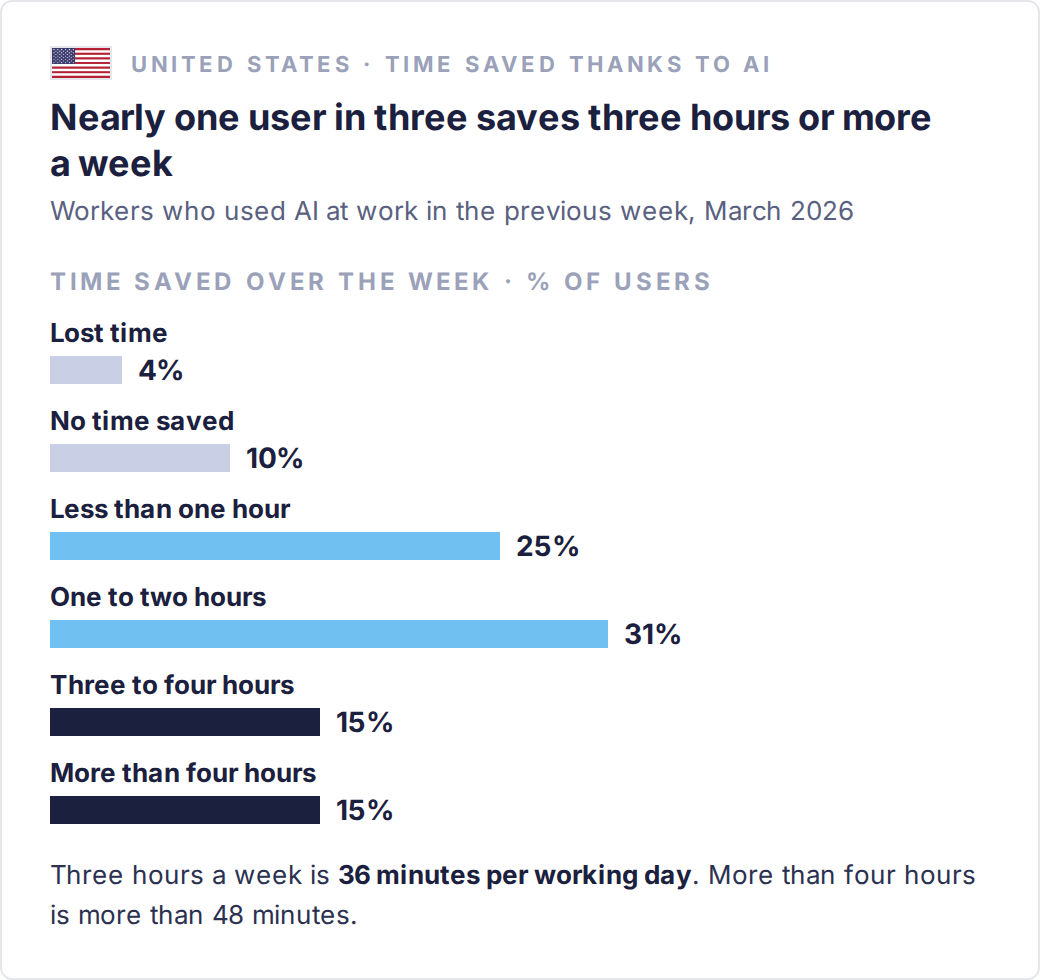
Source: U.S. Census Bureau, “AI Use at Work”, Household Trends and Outlook Pulse Survey, article of 11 August 2026, figures revised in September 2026; US workers, data collected online from 13 to 30 March 2026; time saved asked of workers who had used AI at work in the previous week. Official statistics, self-reported. Reliability: A.
- 01In France, AI is used above all for writing and research: nearly one user in two uses it for these tasks, and these uses are still growing. Data analysis and agents remain minority uses.
- 02Two Americans in three have tried AI, but they use it less often than the British, the Dutch or the Chinese. Among rich countries, they come last for daily use.
- 03Nearly one American user in three saves three hours or more a week thanks to AI, which is at least 36 minutes a day. For 15%, the time saved already exceeds 48 minutes a day.
Get the weekly letter
Every week: the data signals that matter, the number of the week, and what we measure among our clients. Free, no advertising. The letter is sent in French; every issue is also published in English on this site.
One letter a week, on Sunday, written in French. Unsubscribe in one click, at any time.